

There is nothing in the world, I venture to say, that would so effectively help one to survive even the worst conditions as the knowledge that there is a meaning in one's life.
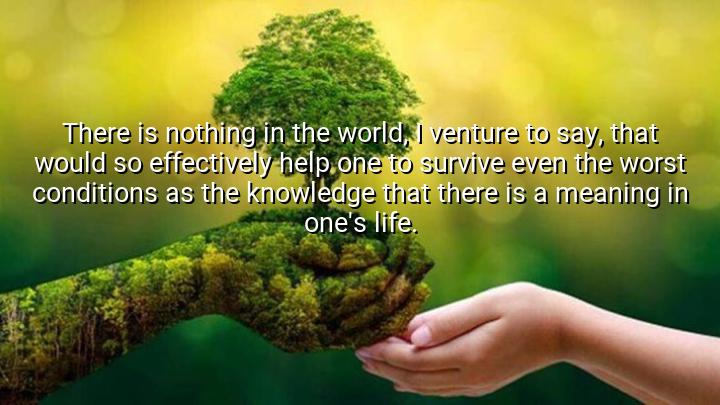




The quote, “There is nothing in the world, I venture to say, that would so effectively help one to survive even the worst conditions as the knowledge that there is a meaning in one's life,” is attributed to Viktor E. Frankl, the Austrian neurologist, psychiatrist, and Holocaust survivor. Frankl is best known for his book Man’s Search for Meaning, where he recounts his experiences in Nazi concentration camps and presents his psychological approach called logotherapy. This statement reflects his central belief that the human capacity to endure suffering is tied to the conviction that life holds meaning.
The first part, “help one to survive even the worst conditions,” speaks directly to Frankl’s own survival during the Holocaust. He observed that prisoners who could not find a sense of purpose often gave in to despair, while those who held onto meaning—whether through love, faith, or future goals—were better able to endure unimaginable suffering. For Frankl, the search for meaning was not just psychological but existential.
The second part, “the knowledge that there is a meaning in one’s life,” emphasizes the importance of belief and perspective. Even when external freedoms are stripped away, the inner conviction that one’s life has purpose provides strength and resilience. This form of knowledge is not factual but deeply personal, grounded in the spiritual and emotional dimensions of human existence.
Ultimately, Frankl’s insight became the foundation of logotherapy, which teaches that finding meaning is the primary motivation in life. His words remind us that survival is not merely about physical endurance but also about the human spirit’s need for significance. By anchoring ourselves in purpose, we gain the strength to face adversity with courage and hope.

AAdministratorAdministrator
Welcome, honored guests. Please leave a comment, we will respond soon