

To reduce the risk of a global environmental catastrophe, and to avoid reversing the course of human progress, the world must urgently bend the curve of global emissions away from fossil fuels.
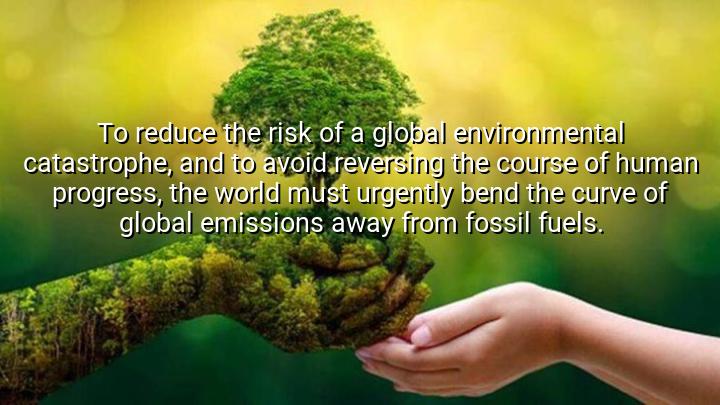




Johan Rockström’s quote underscores the urgent need to address global environmental risks, particularly those posed by the continued reliance on fossil fuels. The phrase "bend the curve" refers to the critical need to shift the trajectory of global emissions away from fossil fuel consumption, which is a major driver of climate change. Rockström emphasizes that this shift is necessary not just to protect the environment but also to ensure that human progress—in terms of technological development, economic growth, and social well-being—does not backslide.
The term "global environmental catastrophe" alludes to the potentially devastating consequences of unchecked environmental degradation, such as extreme weather events, rising sea levels, and mass species extinction, all of which are exacerbated by fossil fuel use. Rockström warns that if emissions continue to rise unchecked, the world could face irreversible damage that would undermine human progress and sustainable development. His call for urgent action highlights the urgency of addressing these issues to avoid catastrophic outcomes.
Rockström, a prominent environmental scientist and director of the Stockholm Resilience Centre, has long advocated for sustainable development and a planetary boundaries framework—a concept that identifies critical thresholds in Earth's systems that, if crossed, could trigger irreversible environmental damage. His statement reflects his expertise and his concern for the balance between continued economic growth and the planet’s health, urging global leaders to prioritize sustainability.
In this quote, Rockström is essentially calling for a paradigm shift in global energy systems—one that transitions from fossil fuels to renewable energy sources such as wind, solar, and geothermal power. This shift is not only essential for mitigating the effects of climate change but also for securing a sustainable future for all nations. He stresses that the time to act is now to avoid potentially devastating impacts on the planet and humanity’s future.

AAdministratorAdministrator
Welcome, honored guests. Please leave a comment, we will respond soon