

To hope means to be ready at every moment for that which is not yet born, and yet not become desperate if there is no birth in our lifetime.
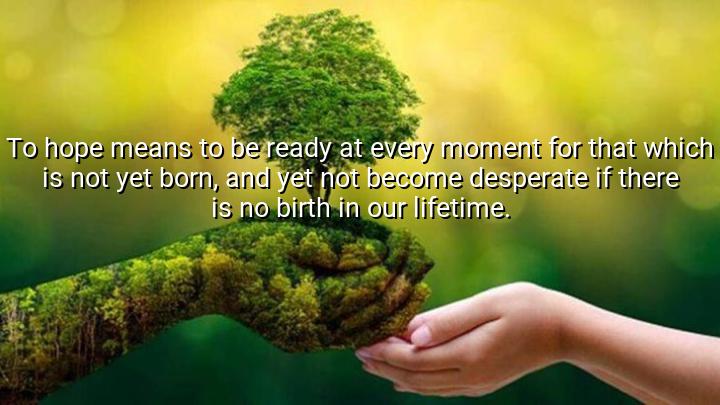




In this quote, Erich Fromm, a German social psychologist and philosopher, explores the concept of hope as both a state of readiness and patience. He suggests that to hope is to be prepared at every moment for something new or transformative—something "not yet born" but that holds the potential to emerge. Hope is about staying open to the future and maintaining a sense of optimism, even when the desired outcome hasn't materialized yet.
Fromm also highlights an important aspect of hope: the ability to remain hopeful without becoming desperate or disillusioned if what is hoped for doesn't come to fruition within one's lifetime. This speaks to the long-term nature of certain goals or changes, particularly when they involve societal or cultural shifts that may take generations to achieve. Hope, in this sense, is not about immediate gratification but about a long-term vision for what could be.
The quote encourages a perspective of steadfastness and resilience in the face of uncertainty, implying that hope is not just about waiting for immediate rewards but about maintaining faith in a greater, slower-moving process. Fromm suggests that hope is a source of strength, even in the absence of tangible results, and it requires both vision and acceptance of life's inevitable delays.
Ultimately, Fromm’s words teach that true hope involves not only the anticipation of future possibilities but also the acceptance of time’s limitations. It calls for a balance between staying patient for what is yet to come and not allowing the absence of immediate results to diminish one’s faith or purpose. Hope, therefore, is a sustaining force that can guide individuals even in the most uncertain or slow-changing circumstances.

AAdministratorAdministrator
Welcome, honored guests. Please leave a comment, we will respond soon