

To be or not to be. That's not really a question.
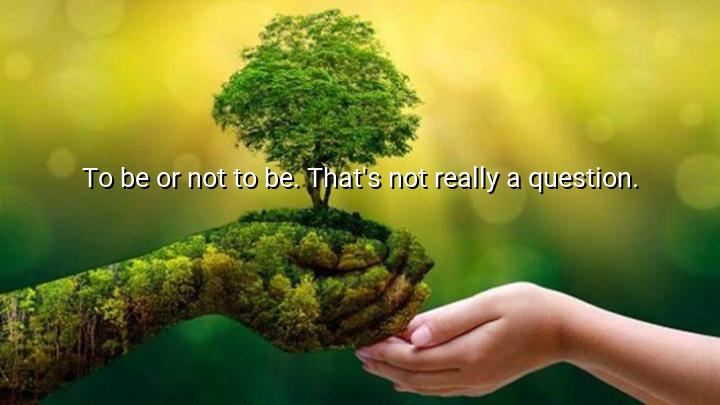




The quote "To be or not to be. That's not really a question" by Jean-Luc Godard offers a reinterpretation of one of the most famous lines in Shakespeare's Hamlet. In the original play, Hamlet's "To be or not to be" is a deeply philosophical query about existence, life, and death. Godard, a French filmmaker and revolutionary figure in cinema, distills this existential dilemma into a more playful and provocative statement. By asserting that it’s "not really a question," he challenges the seriousness with which we often approach such profound themes, suggesting that the true complexities of life and death cannot be reduced to simple choices or dichotomies.
Godard's quote reflects his cinematic philosophy, particularly his approach to filmmaking, which often involved breaking traditional narrative structures and challenging the conventions of storytelling. His work in the French New Wave (e.g., Breathless and Alphaville) redefined how movies dealt with themes of identity, society, and human nature, often questioning deeply held assumptions. In this quote, he critiques the philosophical weight of Shakespeare's question, perhaps suggesting that such a binary choice is overly simplistic or irrelevant in the modern world, where the complexities of human existence go far beyond any straightforward dilemma.
The origin of the quote lies in Godard's broader approach to both art and life, where he often explored the idea of challenging traditional ways of thinking. As a filmmaker, he sought to break down the barriers between art and reality, and his words reflect this desire to reject overly simplistic or conventional viewpoints. In this case, Godard takes a universally recognized literary reference and flips it, making a statement that pushes the audience to rethink the nature of existential questions.
Ultimately, Godard's quote serves as a provocative commentary on how we approach life and existence. It suggests that such profound questions may not be as straightforward or binary as they appear, urging us to consider the deeper, often unanswerable aspects of human experience. In typical Godard fashion, the quote is a call to question and challenge rather than simply accept conventional thinking.

AAdministratorAdministrator
Welcome, honored guests. Please leave a comment, we will respond soon