

To be clear, climate change is a true 800 pound gorilla in the room. The effects of global warming threaten global environmental upheaval over the coming century. But for South Florida and the Everglades, it could be our death knell if urgent action is not taken.
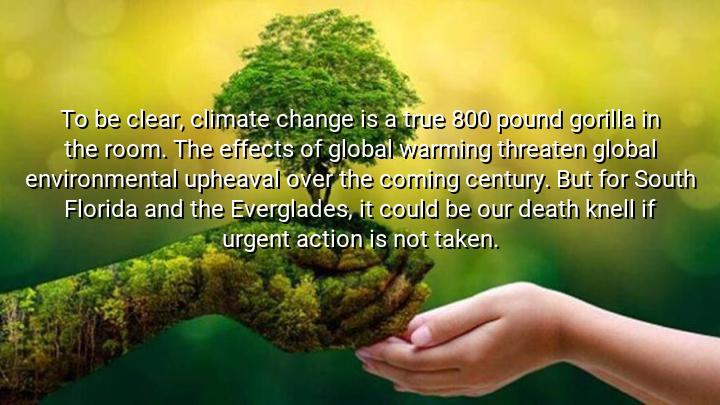




Debbie Wasserman Schultz’s quote uses the metaphor of the “800-pound gorilla in the room” to highlight the urgent and undeniable threat of climate change. She suggests that global warming is a massive issue that is often overlooked or downplayed, despite its potential to cause environmental upheaval on a global scale. For South Florida and the Everglades, Wasserman Schultz argues, the consequences could be catastrophic, leading to the “death knell” of these vital ecosystems if urgent action is not taken. Her statement emphasizes the gravity of the situation and the need for immediate, decisive steps to mitigate the effects of climate change in vulnerable regions.
The origin of this quote comes from Wasserman Schultz’s role as a U.S. Representative from Florida, where she has been a vocal advocate for addressing climate change and protecting the state’s unique ecosystems. Florida, and particularly the Everglades, are highly susceptible to the impacts of rising sea levels and extreme weather events driven by climate change. Wasserman Schultz’s comments are a call to action, urging both local and national leaders to prioritize environmental policies that can prevent or mitigate these dire consequences.
In this context, the Everglades serve as a symbol of the larger environmental threats posed by climate change, including sea level rise, ecosystem destruction, and the loss of biodiversity. The region is particularly vulnerable due to its low-lying nature and proximity to the ocean, and any increase in global temperatures or shifts in weather patterns could have devastating effects. Wasserman Schultz stresses that if South Florida and the Everglades are not protected through urgent, proactive measures, these areas could face irreversible damage.
Ultimately, Wasserman Schultz’s quote underscores the importance of addressing climate change at both the local and global levels. By framing climate change as an immediate and existential threat to regions like South Florida, she calls for strong action to safeguard the environment and prevent further harm. Her statement serves as a reminder that failure to act now could result in long-term consequences for both the planet and its most vulnerable ecosystems.

AAdministratorAdministrator
Welcome, honored guests. Please leave a comment, we will respond soon