

To accuse others for one's own misfortunes is a sign of want of education. To accuse oneself shows that one's education has begun. To accuse neither oneself nor others shows that one's education is complete.
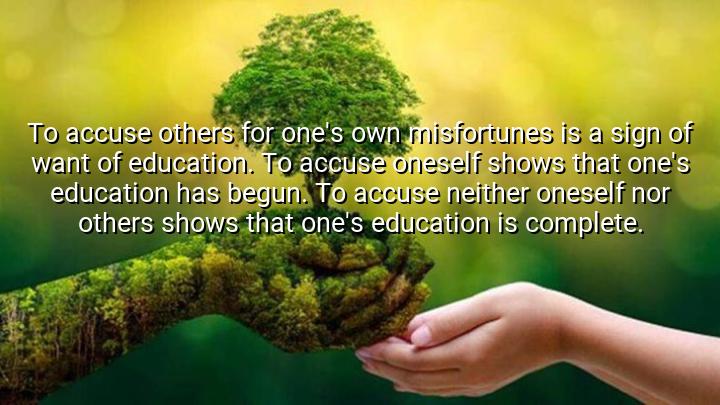




The quote “To accuse others for one's own misfortunes is a sign of want of education. To accuse oneself shows that one's education has begun. To accuse neither oneself nor others shows that one's education is complete.” by Epictetus explores the philosophical understanding of personal responsibility and self-awareness. Epictetus, a Stoic philosopher, emphasizes that true education extends beyond academic learning to include moral and emotional development. How one responds to misfortune reveals the depth of one’s inner education and wisdom.
By stating that blaming others indicates a “want of education,” Epictetus highlights that uneducated individuals often lack the self-discipline and critical thinking necessary to understand their circumstances. Conversely, recognizing one’s own role in challenges suggests the beginning of self-awareness and personal growth, a crucial stage in education beyond mere book knowledge.
The highest stage, according to Epictetus, is to accuse neither oneself nor others, reflecting a mindset of equanimity, acceptance, and understanding of life’s inherent unpredictability. This illustrates the Stoic principle that wisdom lies in focusing on what one can control while remaining indifferent to external events beyond one’s influence.
The origin of this quote comes from Epictetus’ teachings in Stoic philosophy, particularly his emphasis on the cultivation of virtue, rational judgment, and inner freedom. Ultimately, this quote serves as a reminder that education is not only intellectual but also ethical and emotional, guiding individuals toward responsibility, self-mastery, and a balanced approach to life’s challenges.

AAdministratorAdministrator
Welcome, honored guests. Please leave a comment, we will respond soon