

Those who say religion has nothing to do with politics do not know what religion is.
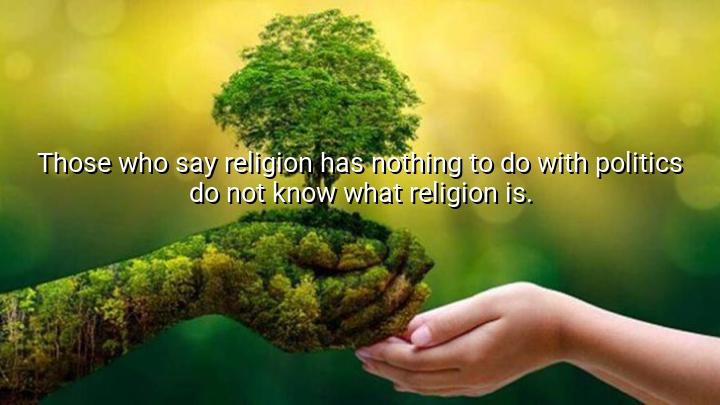




In this quote, Mahatma Gandhi asserts that religion and politics are deeply intertwined and cannot be considered separate. He argues that those who claim religion has no role in politics are misunderstanding the true essence of both. For Gandhi, religion was not merely a personal or spiritual practice, but a guiding force that shaped an individual's moral values, decisions, and actions. If one’s moral compass is influenced by their religion, then it inevitably impacts their approach to governance, social justice, and the laws that structure society.
Gandhi’s viewpoint challenges the common idea of secularism that tries to keep religion and politics apart. He believed that political decisions should be guided by moral principles that often stem from religious teachings, such as compassion, nonviolence, and justice. Gandhi’s own life exemplified this interconnectedness, as he drew on his Hindu beliefs to lead the Indian independence movement through nonviolent civil disobedience. His leadership was a reflection of his belief that spirituality and politics are not opposing forces, but that the former should guide the ethical and moral underpinnings of the latter.
The origin of this quote lies in Gandhi’s broader philosophy of truth and nonviolence (Ahimsa), which he practiced both personally and politically. Gandhi rejected the idea of dividing one’s spiritual and political life, arguing that true ethical governance cannot be achieved without grounding it in moral and religious values. He saw the political struggle for independence from British rule as not just a national or secular cause, but one deeply tied to his spiritual mission of self-realization and freedom.
For Gandhi, religion provided a framework for understanding justice, equality, and the common good. His belief in the unity of religion and politics stands as a challenge to modern notions of secularism and highlights how deeply held values and spiritual convictions inevitably influence public life. This quote serves as a reminder that, for Gandhi, a true political leader must be someone whose moral integrity and spiritual commitment guide their actions in both personal and public spheres.

AAdministratorAdministrator
Welcome, honored guests. Please leave a comment, we will respond soon