

They can rule the world while they can persuade us our pain belongs in some order is death by famine worse than death by suicide, than a life of famine and suicide?
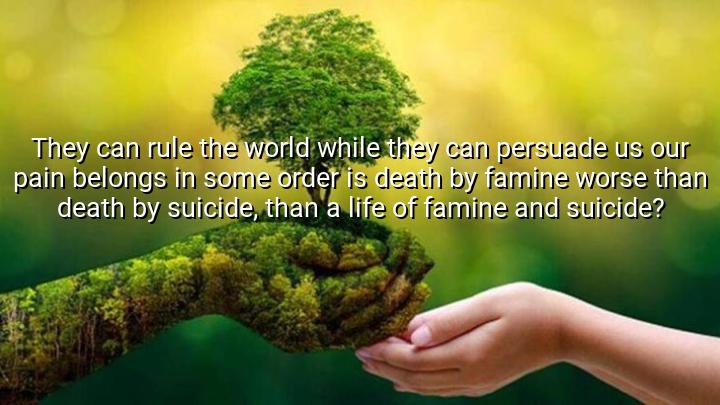




The quote "They can rule the world while they can persuade us our pain belongs in some order is death by famine worse than death by suicide, than a life of famine and suicide?" by Adrienne Rich explores the manipulation of suffering and how those in power can influence perceptions of pain and despair. Rich suggests that societal structures often impose an order on suffering, making some forms of pain seem more acceptable or tragic than others. By questioning whether death by famine is worse than death by suicide or a life filled with both, she critiques how different forms of suffering are judged and valued differently by society.
Rich’s words challenge the way society hierarchizes pain, implying that it is a tool of those in power to control and diminish the personal nature of suffering. By framing these extreme forms of suffering—famine, suicide, and prolonged misery—within the same question, Rich invites us to reflect on the desperation and hopelessness that drive people to extreme actions. Her quote points to how social systems often fail to address the underlying causes of such pain and instead push individuals to see their struggles as isolated events, rather than part of a larger pattern of systemic failure.
The origin of this quote lies in Rich’s work as a poet and feminist who frequently explored themes of power, social justice, and inequality. Known for her sharp critique of patriarchy, oppression, and societal structures, Rich often highlighted how power dynamics shape individual experiences, particularly for marginalized groups. In this quote, she uses the concept of suffering to expose how society distorts and manipulates perceptions of individual pain to maintain control.
Ultimately, this quote serves as a call to recognize and address the injustice behind the social systems that create and perpetuate suffering. Rich is urging us to think critically about the ways in which society makes us view pain as something that can be measured, ranked, or justified, rather than addressing the deeper causes of human despair and inequality.

AAdministratorAdministrator
Welcome, honored guests. Please leave a comment, we will respond soon