

There seems to be a terrible misunderstanding on the part of a great many people to the effect that when you cease to believe you may cease to behave.
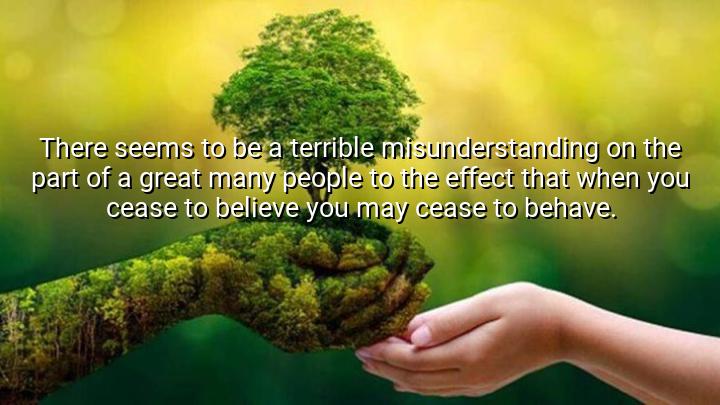




Louis Kronenberger’s quote, "There seems to be a terrible misunderstanding on the part of a great many people to the effect that when you cease to believe you may cease to behave," addresses a common misconception about the relationship between belief and behavior. Kronenberger suggests that some individuals assume that once they no longer adhere to a particular set of beliefs, their moral behavior or ethical conduct will be compromised. This misunderstanding assumes that belief systems—whether religious, philosophical, or ideological—are the sole driving force behind good behavior, while absence of belief somehow leads to immorality or chaos.
Kronenberger’s quote challenges the idea that belief is the only source of moral guidance. He implies that one does not need a particular belief system to continue to act in an ethical or responsible manner. This notion also speaks to the idea that morality can be independent of religious or doctrinal beliefs. It suggests that human behavior and integrity are not necessarily tied to adherence to a belief but can be governed by broader principles like reason, empathy, and conscience.
The origin of this quote comes from Kronenberger’s reflections on the nature of belief and ethics. As a writer and critic, he observed the philosophical and societal trends of his time, particularly the growing secularization of society and the rise of skepticism. His comment reflects his concern that individuals were confusing loss of belief with loss of moral direction, assuming that faith or doctrine was the only guide for ethical decision-making.
In essence, Kronenberger is reminding us that ethical behavior doesn’t depend solely on belief in a higher power or ideology. Reason, compassion, and personal responsibility can serve as foundations for good conduct. His quote encourages the idea that moral and ethical actions are possible and necessary, regardless of one’s belief system, and that human behavior can be guided by a sense of responsibility and empathy for others.

AAdministratorAdministrator
Welcome, honored guests. Please leave a comment, we will respond soon