

There is one Physician, of flesh and of spirit, originate and unoriginate, God in man, true Life in death, son of Mary and son of God, first passible and then impassible: Jesus Christ our Lord.
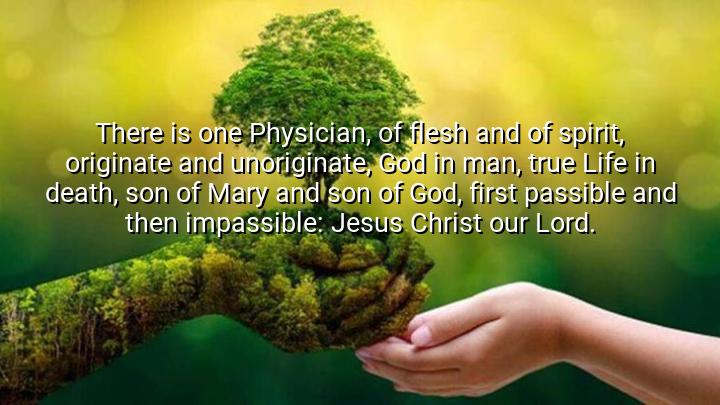




Ignatius of Antioch’s quote, “There is one Physician, of flesh and of spirit, originate and unoriginate, God in man, true Life in death, son of Mary and son of God, first passible and then impassible: Jesus Christ our Lord,” reflects his deep theological understanding of Jesus Christ as both fully human and fully divine. Ignatius, one of the early Christian Church Fathers, is emphasizing the complex and mystical nature of Christ’s dual existence. He is presented as both a human being, born of Mary, and as the divine Son of God—the savior who transcends both life and death.
The phrase “true Life in death” highlights the central Christian belief that through Christ’s death on the cross, eternal life is granted to humanity. Ignatius suggests that even in death, Jesus embodies the fullness of life, showing that life and death are not opposites, but deeply intertwined through Christ’s sacrifice. The transition from “passible” (able to suffer) to “impassible” (incapable of suffering) marks the transformation Christ undergoes in his resurrection, symbolizing his victory over death and suffering.
Ignatius, as one of the earliest voices in Christian theology, helped shape the doctrine of the incarnation, where God is fully expressed in the person of Jesus Christ. His writings often reflect an understanding of Christ’s work as a healer of both the body and the soul, bridging the gap between the earthly and the divine. By calling Jesus the Physician of both flesh and spirit, Ignatius is emphasizing the holistic nature of Christ’s work—healing both the physical and spiritual wounds of humanity.
Ultimately, this quote encapsulates Ignatius’ vision of Jesus Christ as a complex figure who is both human and divine, suffering and triumphant, able to heal and bring eternal life to all. It underscores the mystery of the incarnation and the salvific power of Christ's death and resurrection, a cornerstone of Christian belief that continues to influence theological thought today.

AAdministratorAdministrator
Welcome, honored guests. Please leave a comment, we will respond soon