

There is no such thing as death. In nature nothing dies. From each sad remnant of decay, some forms of life arise so shall his life be taken away before he knoweth that he hath it.
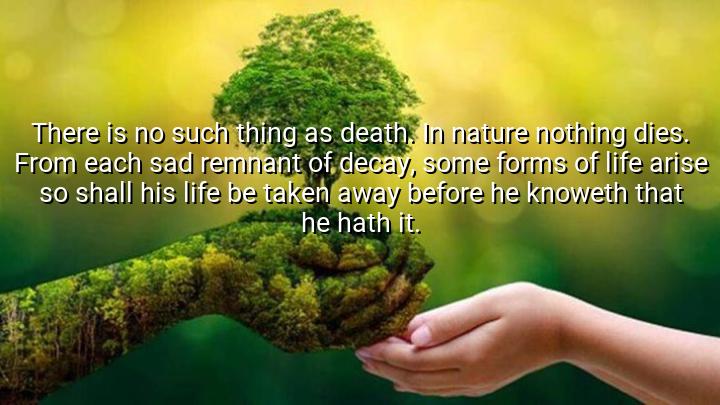




Charles Mackay’s quote, "There is no such thing as death. In nature nothing dies. From each sad remnant of decay, some forms of life arise so shall his life be taken away before he knoweth that he hath it," reflects a philosophical and naturalistic view of existence. Mackay, a 19th-century Scottish poet and journalist, is expressing the idea that death is not an end but a transformation. In the natural world, the processes of decay and decomposition are not final; they give rise to new forms of life. In this sense, death is simply a stage in the ongoing cycle of renewal.
The first part of the quote—"There is no such thing as death. In nature nothing dies"—emphasizes the continuity of existence. While individual organisms may cease to live, their physical matter is recycled back into the earth, sustaining other forms of life. This perspective is deeply rooted in both ecological and spiritual traditions, where the interconnection of all things ensures that nothing is ever truly lost, only transformed.
Mackay extends this thought into the human condition, suggesting that "his life be taken away before he knoweth that he hath it." This line reflects the fragility and brevity of human existence. Many people pass through life without fully realizing its value or purpose, and in this way, death may come before they truly recognize what it means to live. The warning here is that while death is inevitable, failing to appreciate life while it lasts is the greater tragedy.
In essence, Mackay’s quote weaves together themes of mortality, transformation, and awareness. While he acknowledges the inevitability of death, he reframes it as part of a larger natural cycle in which life continues. At the same time, he cautions us not to overlook the significance of living meaningfully before death arrives. This balance of natural philosophy and human insight makes his words both timeless and profound.

AAdministratorAdministrator
Welcome, honored guests. Please leave a comment, we will respond soon