

There is no more reason to pay for private education than there is to pay for a private swimming pool for those who do not use public facilities.
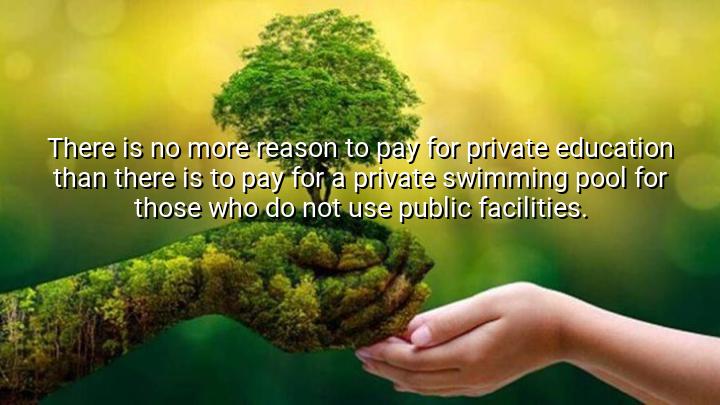




The quote by Albert Shanker critiques the idea of paying for private education when public options are available. Shanker argues that just as it would be unnecessary to pay for a private swimming pool if public facilities suffice, it is similarly unreasonable to prioritize private schooling over accessible public education. The statement underscores the value of public institutions in providing equitable opportunities for all members of society.
By drawing this analogy, Shanker emphasizes the principle of equal access to essential resources, such as quality education. He suggests that spending on private alternatives may benefit a few individuals, but it does not address broader societal needs or improve the public system that serves the majority. The quote reflects a concern for social equity and the efficient use of communal resources.
The origin of this quote comes from Albert Shanker (1928–1997), an American labor leader and president of the American Federation of Teachers. Shanker was a strong advocate for improving public education, teachers’ rights, and equitable access to learning. His comparison reflects his belief that education should serve the public good rather than cater exclusively to those who can afford private options.
Ultimately, this quote highlights the importance of investing in public education as a shared societal responsibility. It encourages readers to consider the value of accessible learning for all, reminding us that educational opportunities should be equitable and inclusive rather than restricted to a privileged few.

AAdministratorAdministrator
Welcome, honored guests. Please leave a comment, we will respond soon