

There is no life to be found in violence. Every act of violence brings us closer to death. Whether it's the mundane violence we do to our bodies by overeating toxic food or drink or the extreme violence of child abuse, domestic warfare, life-threatening poverty, addiction, or state terrorism.
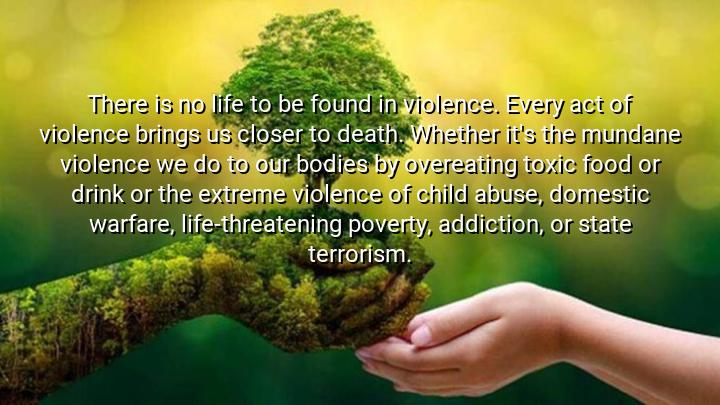




The quote by bell hooks, “There is no life to be found in violence. Every act of violence brings us closer to death…”, is a profound reflection on the destructive nature of violence in all its forms. hooks draws attention not only to overt, extreme violence such as child abuse, state terrorism, or domestic warfare, but also to more subtle, everyday acts of self-harm and neglect, like consuming toxic food or living in addiction. Her message challenges us to recognize that violence is not limited to physical harm—it includes systemic, emotional, and even nutritional dimensions.
As a prominent feminist theorist, cultural critic, and social activist, bell hooks dedicated much of her work to exploring themes of oppression, healing, and love. This quote reflects her belief that violence, whether inflicted by others or by ourselves, erodes our sense of humanity, connection, and well-being. She sees the cumulative impact of all types of violence as a gradual pull toward death—not just literal death, but the death of spirit, community, and personal integrity.
By linking personal choices such as overeating with larger social injustices like poverty and terrorism, hooks emphasizes the interconnectedness of all acts of harm. This perspective pushes readers to consider how individual behaviors, institutional systems, and cultural norms can all perpetuate violence. Her use of the phrase “mundane violence” is especially striking, reminding us that small, often unnoticed habits can be just as damaging in the long term as more visible forms of brutality.
Ultimately, bell hooks’ quote is a call to pursue nonviolence, self-care, and social justice as essential to truly living. She invites us to cultivate environments that support life, growth, and healing, rather than contributing to the cycle of harm. Her words serve as both a warning and an invitation—to be more conscious, more compassionate, and more committed to a world where life-affirming choices are the norm.

AAdministratorAdministrator
Welcome, honored guests. Please leave a comment, we will respond soon