

Class is more than money. Class is also about knowledge.
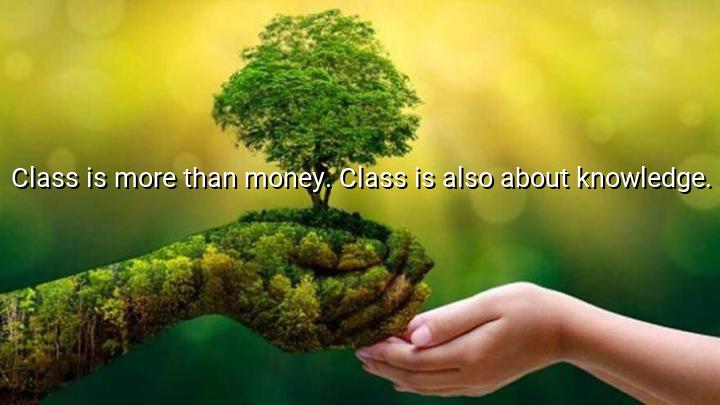




The quote “Class is more than money. Class is also about knowledge.” is attributed to bell hooks, the cultural critic, feminist theorist, and educator. At its heart, the statement expands the definition of class beyond economic wealth. Hooks emphasizes that while money determines material status, knowledge—access to education, cultural awareness, and intellectual empowerment—also plays a critical role in shaping a person’s social position and opportunities in life.
The origin of this idea can be found in hooks’ broader work on race, gender, and class, where she often analyzed how systems of power intersect. In books like Where We Stand: Class Matters, she argued that class is not solely determined by financial resources, but also by access to knowledge and the ability to navigate cultural and intellectual spaces. For hooks, understanding class required looking beyond income to include the social and cultural tools that empower individuals.
The meaning of the quote underscores that true privilege involves more than wealth. A wealthy person without knowledge may lack influence or the ability to fully engage in society, while someone with limited financial resources but strong education and awareness can often challenge structures of inequality and advocate for change. Hooks suggests that knowledge is transformative—it not only shapes how people understand themselves but also how they interact with and influence the wider world.
Ultimately, hooks’ statement is a call to rethink how we define class and status. By highlighting the role of knowledge, she challenges us to consider education and intellectual growth as equally vital measures of empowerment. Her insight points to the idea that social justice and equality cannot be achieved by redistributing wealth alone; they also require expanding access to learning, critical thinking, and cultural understanding.

AAdministratorAdministrator
Welcome, honored guests. Please leave a comment, we will respond soon