

There is a cult of ignorance in the United States, and there has always been. The strain of anti-intellectualism has been a constant thread winding its way through our political and cultural life, nurtured by the false notion that democracy means that my ignorance is just as good as your knowledge.
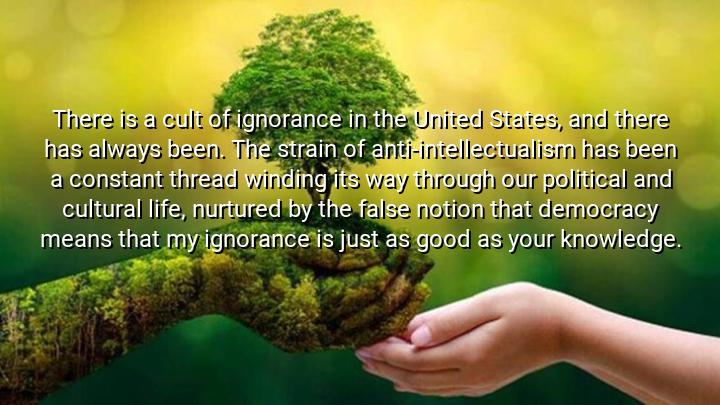




The quote, “There is a cult of ignorance in the United States, and there has always been. The strain of anti-intellectualism has been a constant thread winding its way through our political and cultural life, nurtured by the false notion that democracy means that my ignorance is just as good as your knowledge,” is attributed to Isaac Asimov, the American writer and biochemist renowned for his works of science fiction and popular science. Asimov often reflected on the relationship between knowledge, science, and society, warning against complacency in intellectual life. This statement comes from his 1980 essay “A Cult of Ignorance,” published in Newsweek, where he criticized the growing anti-intellectualism in American culture.
The first part, “a cult of ignorance… a constant thread winding its way through our political and cultural life,” highlights Asimov’s observation that anti-intellectualism is not new but deeply rooted in American history. He believed that suspicion of intellectuals, experts, and education often reappeared in society, undermining rational discourse and scientific progress. This strain, according to him, weakens democratic institutions by devaluing knowledge and expertise.
The second part, “nurtured by the false notion that democracy means that my ignorance is just as good as your knowledge,” exposes a dangerous misunderstanding of democracy. While democracy ensures equality of rights and voices in governance, Asimov warned that it does not mean all ideas carry equal weight regardless of their basis in fact. To confuse ignorance with equality, he argued, undermines truth and rational decision-making.
Ultimately, Asimov’s quote is both a critique and a warning. He underscores the importance of respecting knowledge and combating anti-intellectualism if democracy is to function effectively. His words remain strikingly relevant today, reminding us that freedom and equality must be grounded in truth, evidence, and respect for expertise rather than the glorification of ignorance.

AAdministratorAdministrator
Welcome, honored guests. Please leave a comment, we will respond soon