

Suppose that we are wise enough to learn and know - and yet not wise enough to control our learning and knowledge, so that we use it to destroy ourselves? Even if that is so, knowledge remains better than ignorance.
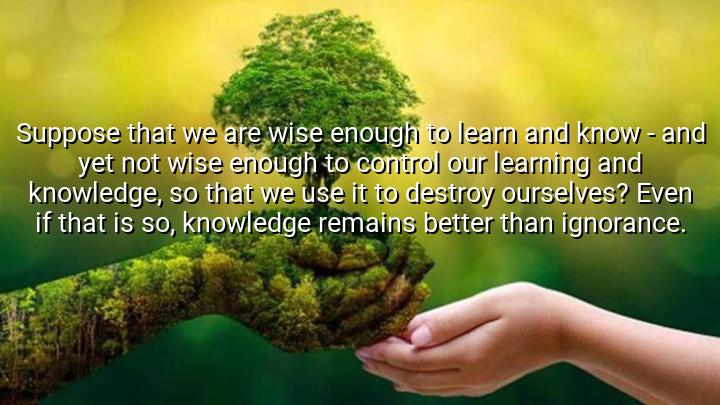




The quote "Suppose that we are wise enough to learn and know - and yet not wise enough to control our learning and knowledge, so that we use it to destroy ourselves? Even if that is so, knowledge remains better than ignorance." by Isaac Asimov highlights the dual-edged nature of knowledge. Asimov warns that human beings might achieve great intellectual progress, but without the wisdom to guide and control its application, such progress could lead to self-destruction. Yet, despite this danger, he firmly believes that knowledge is still superior to ignorance.
The meaning of this quote lies in the distinction between learning and the responsible use of knowledge. While knowledge can create risks—such as technological advancements leading to weapons of mass destruction—it also offers the potential for solutions, growth, and enlightenment. Ignorance, on the other hand, leaves humanity powerless, stagnant, and vulnerable. For Asimov, the danger is not in knowledge itself but in the failure to couple it with wisdom and ethical responsibility.
The origin of this thought comes from Asimov’s lifelong exploration of the intersection between science, ethics, and human progress. As a prolific science fiction writer and scientist, he frequently reflected on the consequences of unchecked technological development. This quote echoes themes found in his works such as the Foundation series and Robot series, where the tension between human advancement and moral responsibility is central.
Ultimately, Asimov’s message is that humanity must embrace knowledge, despite its risks, because it is the only path to advancement. While ignorance might feel safer in the short term, it offers no solutions and no growth. The challenge is to ensure that wisdom grows alongside knowledge, so that what we learn uplifts rather than destroys us.

AAdministratorAdministrator
Welcome, honored guests. Please leave a comment, we will respond soon