

There are no rules of architecture for a castle in the clouds.
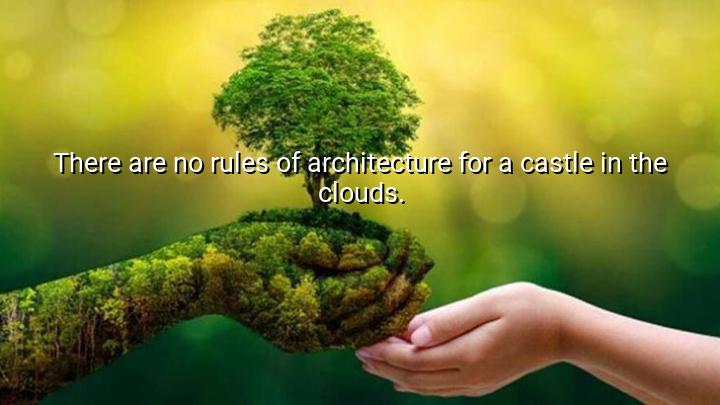




The quote by Gilbert K. Chesterton, "There are no rules of architecture for a castle in the clouds," speaks to the boundless nature of imagination and dreams. Chesterton, a British writer and philosopher, uses the metaphor of a castle in the clouds to represent fantasy, idealism, or unrealized visions. His point is that when something exists only in the realm of the impossible or imaginary, it is not subject to the rules and constraints that govern real-world architecture.
In this context, architecture symbolizes structure, logic, and practicality—elements that are essential when building something in the physical world. But a "castle in the clouds" is not bound by engineering limits, materials, or gravity; it's a dream construct, shaped entirely by the mind. Chesterton is suggesting that creativity and visionary thinking are, at their core, free from regulation—they are limitless and personal.
This quote also serves as a gentle critique of over-rationalization in art and design. Chesterton, known for his wit and love of paradox, often challenged the idea that all things must be rooted in strict reason. By pointing out that some ideas are meant to be unbounded, he encourages artists, writers, and thinkers to embrace the freedom of dreaming, without being confined by reality’s frameworks.
Ultimately, Chesterton's quote celebrates the power of imagination and the beauty of the unattainable. It reminds us that not every idea must be built, measured, or justified. Some visions exist simply to inspire, to lift us beyond the ordinary, and in doing so, they follow no rules but their own.

NC10CT2-04- Phung Nhat Cuong
I can’t help but wonder if this quote is a subtle critique of rigid thinking. Maybe it's saying that innovation can’t flourish if we’re always stuck following rules. Could the idea of a 'castle in the clouds' symbolize a kind of design thinking that values inspiration over engineering? I think this is something every creator wrestles with at some point—how much freedom is too much?
MTD. Minh Thu
I’m intrigued by how this quote implies that some things exist outside conventional systems. Does this apply to more than just architecture—maybe to art, relationships, or even identity? Are there areas in our lives where we should stop trying to impose order and just let the dream be? I love how Chesterton invites that kind of reflection without giving a rigid answer.
VNVy Ngoc
The poetic nature of this quote made me smile, but also question how we treat creative vision. In design or architecture, is there a space for ‘cloud castles,’ purely conceptual ideas that push the boundaries of what's possible, even if they can’t be built? I feel like modern digital modeling and VR are beginning to make room for exactly that.
LMLy Mai
This quote makes me think about the line between fantasy and ambition. Are ‘castles in the clouds’ just unattainable dreams, or are they essential starting points for real-world breakthroughs? I’d love to hear how others interpret this—do you see this as a license for limitless creativity, or as a warning against investing too much in ideas that have no grounding?
TMPhuong 38_Nguyen Tran Minh
Is Chesterton saying that dreaming doesn't require discipline? I’m torn. On one hand, I love the freedom this quote implies—letting creativity roam unchained. On the other, I wonder if even castles in the clouds need some internal logic to be meaningful. Can we truly create something impactful without a framework, or do even our wildest visions have hidden rules we just haven't named yet?