

The worst thing that can happen in a democracy - as well as in an individual's life - is to become cynical about the future and lose hope.
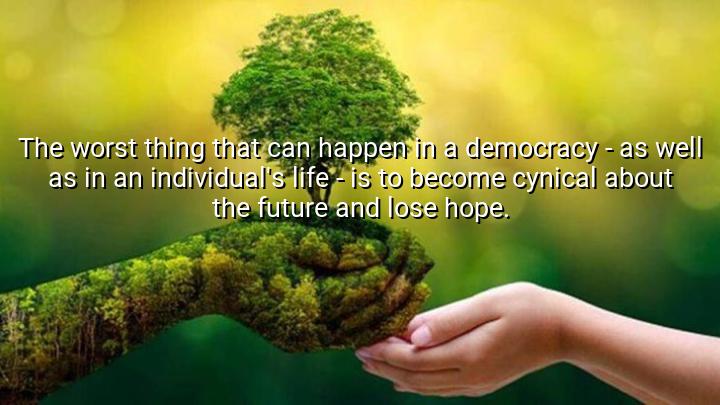




Hillary Clinton’s quote underscores the critical importance of hope and optimism in both personal and societal contexts. By stating, "The worst thing that can happen in a democracy," she emphasizes how cynicism can undermine the very foundation of a democratic system. When people lose hope in the future, they are less likely to participate in or care about the democratic process, which relies on the active engagement of its citizens. This loss of hope can lead to disillusionment and apathy, weakening the democratic system itself.
Clinton also extends this idea to the individual level, noting that cynicism can have equally detrimental effects on a person’s life. Losing hope in one’s own future can lead to feelings of helplessness and inaction, preventing individuals from pursuing their goals or improving their circumstances. For both democracy and personal well-being, the belief in a better future is essential for growth, progress, and the motivation to keep moving forward.
The quote also implies that hope is a driving force behind change and improvement. In a democracy, hope fuels efforts to address societal challenges, whether they involve political reforms, social justice, or economic advancement. On a personal level, hope encourages individuals to continue striving for their dreams and aspirations, even when faced with obstacles.
Ultimately, Clinton’s statement serves as a reminder that hope is not just a feel-good emotion, but a vital force for both societal and personal development. Without it, progress stagnates, and both individuals and societies risk falling into a state of despair and inactivity.

AAdministratorAdministrator
Welcome, honored guests. Please leave a comment, we will respond soon