

In nearly every religion I am aware of, there is a variation of the golden rule. And even for the non-religious, it is a tenet of people who believe in humanistic principles.
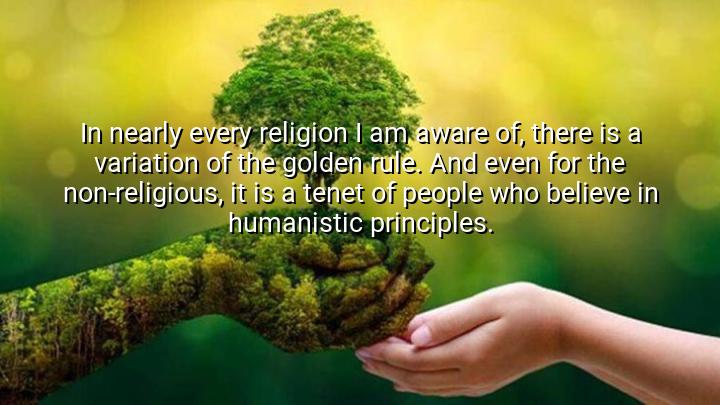




Hillary Clinton’s quote, "In nearly every religion I am aware of, there is a variation of the golden rule. And even for the non-religious, it is a tenet of people who believe in humanistic principles," reflects her belief in the universal importance of treating others with kindness, respect, and empathy. The golden rule, which is often phrased as "treat others as you would like to be treated," is a moral principle that appears in many religions and ethical systems. Clinton points out that this principle is not limited to religious teachings but also resonates with those who follow humanistic or secular values based on the inherent dignity and worth of all people.
Clinton's statement highlights the common ground between religions and secular philosophies, suggesting that despite differing beliefs, there are shared moral values that transcend specific doctrines. The golden rule serves as a reminder that compassion, respect, and fairness are essential to building a just and harmonious society, whether one adheres to a religious faith or follows a humanistic worldview.
By emphasizing the golden rule as a key principle in both religion and humanism, Clinton advocates for moral consistency across different belief systems. She acknowledges that values such as empathy and mutual respect form the foundation for much of human ethical conduct, regardless of whether they are derived from faith-based or secular sources. This inclusivity in her message also encourages a broader, more collaborative approach to social justice and human rights, where shared values can unite people of different backgrounds.
The origin of this quote stems from Clinton’s long-standing advocacy for human rights, equality, and global cooperation. As a politician and former First Lady, she frequently emphasized the importance of shared moral values in bridging divides between cultures and belief systems. Her statement is a reflection of her belief in the power of universal principles to promote peace and understanding, regardless of religious or ideological differences.

AAdministratorAdministrator
Welcome, honored guests. Please leave a comment, we will respond soon