

The religion of the name of the seas will triumph against the sect of the son of Adaluncatif; The obstinate, lamented sect will be fearful of the two wounded by Aleph and Aleph.
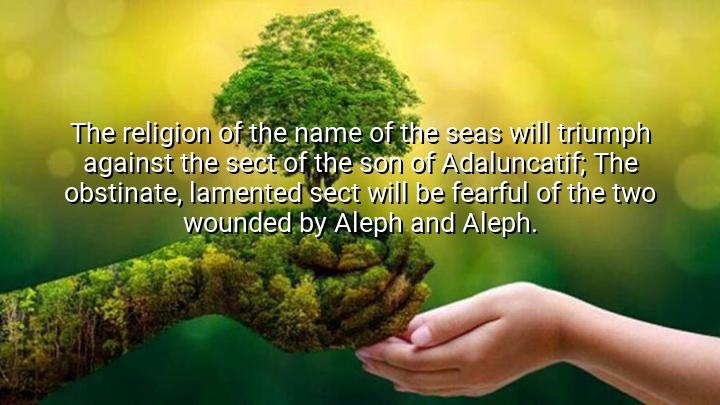




This quote from Nostradamus is an example of his prophetic and often cryptic style of writing. In it, he refers to a religion associated with "the name of the seas" triumphing over a "sect of the son of Adaluncatif," which could symbolize a particular group or belief system. Nostradamus frequently used symbolic language and metaphors, making his prophecies difficult to interpret directly. The "name of the seas" could represent something vast and powerful, like the ocean or a dominant religion, while the "sect" could refer to a competing ideology or belief system that is in conflict.
The mention of "two wounded by Aleph and Aleph" adds another layer of mystery to the prophecy. Aleph is the first letter of the Hebrew alphabet and often symbolizes beginnings, creation, or the divine in esoteric traditions. The "two wounded by Aleph" could symbolize key figures or forces that are wounded or weakened by divine intervention or fateful events. The prophecy suggests that these forces will ultimately lead to the downfall or defeat of the "obstinate, lamented sect," indicating a battle between ideologies or powers.
Nostradamus' origin lies in his practice of writing quatrains that were often vague and open to multiple interpretations. He was a French astrologer and physician, best known for his book Les Prophéties, which contains hundreds of these quatrains, many of which have been linked to major historical events. However, the mystical nature of his writing has led to a wide range of interpretations, with some claiming that his predictions have foretold major world events, while others argue that his quatrains are too ambiguous to be understood clearly.
Ultimately, the quote speaks to the tension between religions or ideologies and the fate of groups or systems that will rise or fall. Nostradamus' writings often hint at an ongoing struggle between forces of good and evil, divine will and human obstinacy. The "triumph" mentioned in the quote suggests a victory for the dominant power—possibly the religion of the seas—while the defeat of the "sect" of the son of Adaluncatif implies a shift in power or belief. The cryptic language and metaphors make it a difficult prophecy to pinpoint but reinforce the themes of change and transformation that run throughout Nostradamus' work.

AAdministratorAdministrator
Welcome, honored guests. Please leave a comment, we will respond soon