

The religion I know most about, which is the Christian one, would simply say that it's not really for one man or woman to know fully and to understand the nature of our brief human existence.
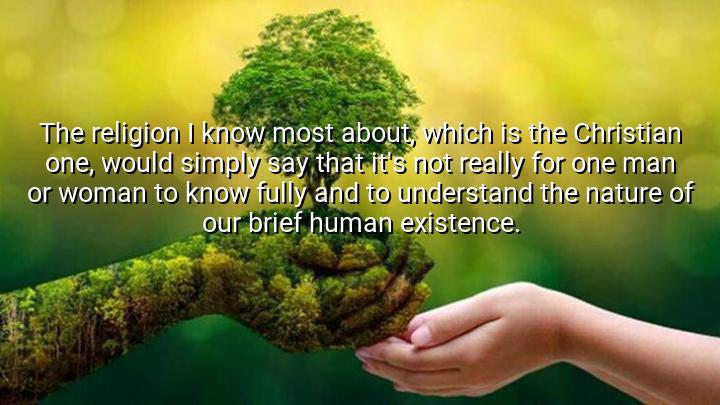




In this quote, Sebastian Faulks, a British author, reflects on the limitations of human understanding regarding the complexities of life and existence. He highlights the Christian perspective, suggesting that the answers to profound existential questions—such as the purpose of life or the nature of human existence—are not fully accessible to any individual. According to Faulks, the Christian faith asserts that humans are not meant to fully comprehend or grasp the mysteries of life, as these are beyond the limits of mortal understanding.
Faulks draws on the Christian teaching that faith often involves acceptance of the unknowable aspects of existence, and that there is a certain humility required in acknowledging our limitations. The quote implies that while religion may provide guidance and wisdom, it does not promise absolute understanding of life's deeper truths. This echoes the Christian belief in the mystery of God's plan and the idea that certain aspects of reality remain hidden or beyond human comprehension.
The quote also touches on the ephemeral nature of human existence. By describing life as "brief," Faulks emphasizes the transitory nature of human experience, reinforcing the idea that there is a transcendent perspective outside of our immediate understanding. In this light, the quest for complete knowledge or answers may be seen as an ultimately futile endeavor—one that encourages humility rather than certainty.
In summary, Faulks' quote highlights a central theme in Christian thought: that humans, in their finite existence, cannot fully understand the vastness of life's meaning. It encourages an attitude of humility and faith, suggesting that we may never fully comprehend our place in the grand scheme of things, and that perhaps this is as it should be. The quote serves as a reminder of the limits of human understanding and the role of religion in providing comfort and direction despite these uncertainties.

AAdministratorAdministrator
Welcome, honored guests. Please leave a comment, we will respond soon