

The prolonged slavery of women is the darkest page in human history.
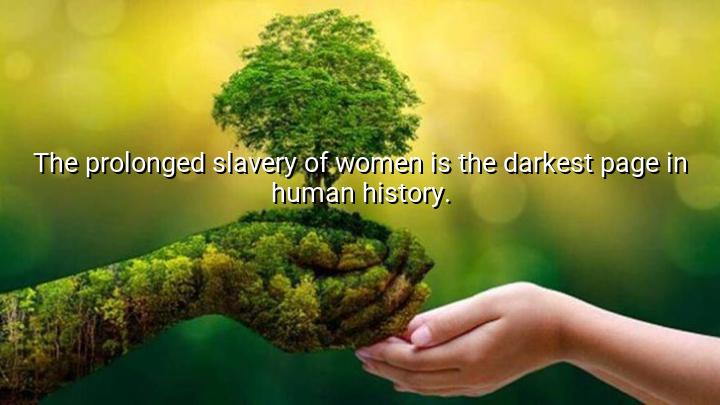




The quote by Elizabeth Cady Stanton emphasizes her view that the slavery of women—their systemic oppression, subjugation, and denial of rights—is one of the greatest injustices in human history. By calling it the “darkest page,” she frames the struggle for women’s equality as not just a social or political issue, but a moral and historical stain comparable to the worst forms of human exploitation.
Stanton’s words highlight the prolonged nature of this oppression. Unlike momentary injustices, the subordination of women has spanned centuries and cut across cultures, making it a deeply ingrained form of inequality. For her, this endurance makes it particularly tragic, as generation after generation of women were denied autonomy, education, political voice, and the ability to participate fully in society.
This perspective also reflects Stanton’s belief that the women’s rights movement was not simply about achieving small reforms, but about correcting a historic injustice. She sought to redefine the place of women in history, insisting that the exclusion and silencing of half the human race represented one of humanity’s most devastating failures. Her words convey urgency and moral weight, intended to awaken society to the depth of the wrong.
The origin of this quote lies in Stanton’s role as a pioneering American suffragist, abolitionist, and social reformer. As a leader in the women’s suffrage movement and co-organizer of the 1848 Seneca Falls Convention, she consistently linked women’s struggles to broader fights for human freedom. This quote captures her conviction that dismantling the slavery of women was not just a political necessity, but an essential step toward justice in the human story.

AAdministratorAdministrator
Welcome, honored guests. Please leave a comment, we will respond soon