

The problem of the Muslim presence is increasingly worrying. There are more and more clashes, more and more demands. And I doubt the compatibility of Italian law with Muslim law, because it's not just a religion but a law.
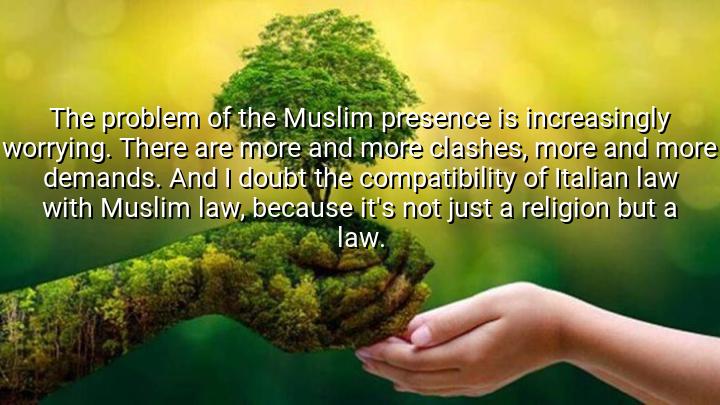




Matteo Salvini’s quote, "The problem of the Muslim presence is increasingly worrying. There are more and more clashes, more and more demands. And I doubt the compatibility of Italian law with Muslim law, because it’s not just a religion but a law," expresses concerns about the integration of Muslim communities within Italian society. Salvini, a prominent Italian politician known for his right-wing views, highlights his belief that the growing presence of Muslims in Italy is creating social tensions and cultural clashes. He frames the issue not just as a religious one, but as a matter of legal and cultural compatibility, suggesting that Islamic practices may be at odds with Italy’s established legal system.
Salvini's argument centers on the idea that Muslim law, or Sharia, extends beyond religious belief and into the realm of governance and law, which he believes could conflict with the principles of Italian law. He contends that if Muslims in Italy follow their own set of rules and regulations—what he views as parallel legal systems—it may lead to further division and undermine national cohesion. This concern reflects broader debates across Europe about the relationship between secular legal systems and religious laws, especially as immigration increases and communities become more diverse.
His statement also plays into the wider political discourse on immigration and cultural integration. Salvini’s rhetoric suggests that the demands of Muslim communities, whether in terms of religious practices, social customs, or political rights, are becoming increasingly difficult to accommodate within Italian society. By highlighting the clashes between Muslim and Italian norms, he frames the issue as one of cultural and national identity, raising concerns about the erosion of Italy's traditions and values.
The quote reveals Salvini's nationalist stance on immigration and integration, and his skepticism about the compatibility of diverse cultural and religious systems within a secular state. It also reflects the broader European debate on the role of Islam in modern society, touching on fears of cultural alienation, radicalization, and the challenge of reconciling diverse legal and ethical frameworks within a unified nation. Ultimately, Salvini’s remarks underline the tension between maintaining national identity and navigating the complexities of a multicultural society.

AAdministratorAdministrator
Welcome, honored guests. Please leave a comment, we will respond soon