

The path of progress cuts through the four-way intersection of the moral, medical, religious and political - and whichever way you turn, you are likely to run over someone's deeply held beliefs.
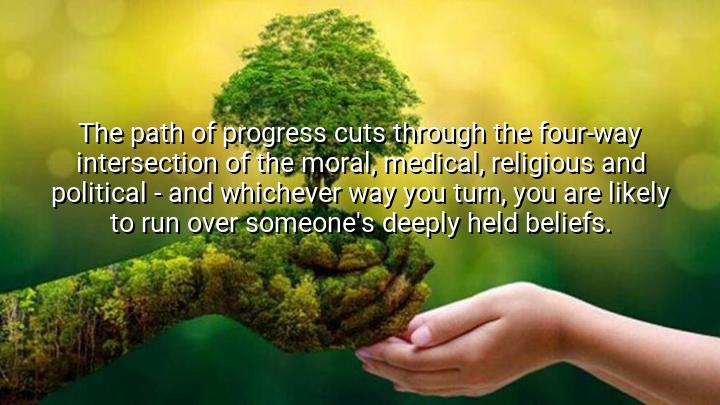




The quote by Nancy Gibbs, “The path of progress cuts through the four-way intersection of the moral, medical, religious and political - and whichever way you turn, you are likely to run over someone's deeply held beliefs,” emphasizes the complexity and sensitivity inherent in driving social change. Gibbs illustrates that efforts to advance progress often intersect with deeply entrenched values and belief systems. The metaphor of a four-way intersection conveys the idea that navigating these domains—morality, medicine, religion, and politics—requires careful consideration, as each direction carries the potential to challenge deeply held beliefs.
The origin of the quote comes from Gibbs’ work as a journalist and commentator, particularly on topics related to policy, culture, and social issues. She often explores how public debates around healthcare, ethics, and legislation collide with personal and societal convictions. In this context, the quote reflects her understanding that meaningful progress rarely occurs in isolation and almost always involves negotiating tensions among ethical, medical, spiritual, and political perspectives.
This statement also highlights the inevitability of conflict in pursuing reforms or innovations. Whether addressing medical breakthroughs, ethical dilemmas, or legislative changes, individuals and policymakers must recognize that progress can inadvertently challenge someone’s beliefs or values. Gibbs’ analogy underscores the need for empathy, dialogue, and compromise when navigating these complex intersections.
Ultimately, the quote serves as both a caution and a guiding principle for those seeking to influence society. Gibbs reminds readers that while the pursuit of progress is necessary, it must be approached with awareness of differing perspectives and a readiness to engage with the moral, medical, religious, and political dimensions of human life. It emphasizes that advancing society requires not only action but also thoughtfulness and respect for the beliefs of others.

AAdministratorAdministrator
Welcome, honored guests. Please leave a comment, we will respond soon