

The past is malleable and flexible, changing as our recollection interprets and re-explains what has happened.
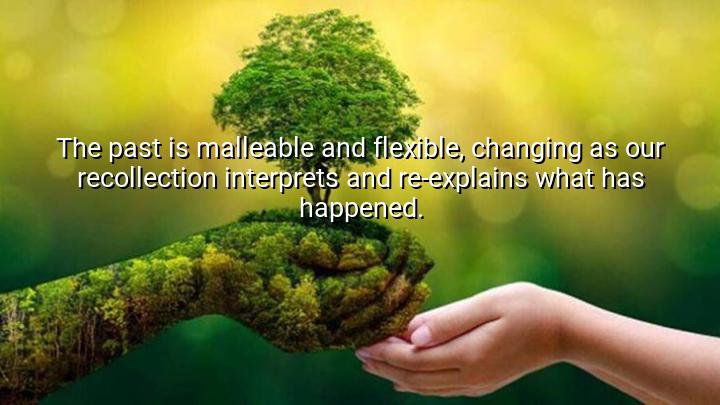




In this quote, Peter L. Berger emphasizes the subjective and dynamic nature of the past. He suggests that our understanding of history is not fixed, but rather, it is shaped and reshaped over time based on how we recollect and interpret events. The past is not a static record of what happened, but a constantly evolving narrative that is influenced by our present-day perspectives, values, and cultural contexts. As we gain new experiences or insights, our interpretation of past events can change.
Berger's idea challenges the notion of history as an objective truth, presenting instead the concept of the past as something that is continuously re-explained. Our recollection of events may change with new information, shifts in societal values, or personal biases, which means that what we consider "history" may evolve over time. For instance, what may have been viewed as a heroic act in one era may be reinterpreted as a misstep or mistake in another, based on how society's collective understanding develops.
The origin of this quote lies within Berger's broader work as a sociologist, particularly his exploration of social constructs and how human perception shapes our understanding of the world. In his writings, Berger often focused on the ways in which societies and individuals create and maintain shared realities, with the past being one of the most fluid aspects of these constructed realities. His work suggests that even our most deeply held beliefs about history are shaped by the social contexts in which we live.
Ultimately, Berger's quote invites us to reflect on the malleability of history and how the way we remember and interpret the past is influenced by the present. It encourages us to recognize that history is not just about what happened, but about how we choose to understand and explain those events, which can change with time and context.

AAdministratorAdministrator
Welcome, honored guests. Please leave a comment, we will respond soon