

The more you look into health and health inequalities, you realize that a lot of it is not due to a particular disease - it's really linked to underlying societal issues such as poverty, inequity, lack of access to safe drinking water and housing. And these are all the things we focus on at CARE.
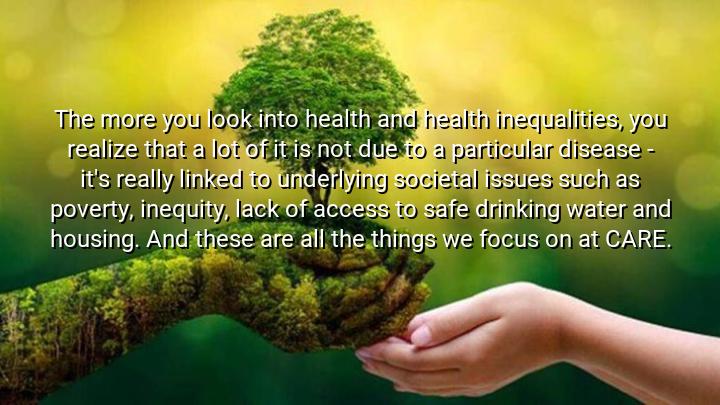




Helene D. Gayle’s quote sheds light on the broader causes of health inequalities, emphasizing that these disparities are often not the result of a single disease but are deeply connected to underlying societal issues. She highlights how poverty, inequity, and lack of access to essential resources like safe drinking water and housing contribute significantly to poor health outcomes. Gayle’s statement challenges the traditional view of health being solely about medical care, underscoring the complex relationship between social determinants and overall well-being.
The quote emphasizes that improving health requires addressing these root causes, which go beyond treating individual diseases or conditions. Health inequalities are often exacerbated by systemic issues like economic inequality, where marginalized populations have limited access to basic necessities. Gayle stresses that tackling these structural problems is critical for improving public health and achieving equitable health outcomes for all communities, particularly the poor and vulnerable.
By mentioning CARE, an organization she has been involved with, Gayle connects the work of the nonprofit sector to addressing these broader social and health issues. CARE focuses on fighting global poverty and providing access to essential resources, recognizing that improving health is intrinsically tied to improving living conditions and economic opportunities. Gayle’s involvement with CARE reflects her commitment to addressing health disparities through sustainable solutions that promote social justice and equity.
Originating from Gayle’s background in global health and leadership roles in organizations focused on social issues, the quote reflects her expertise in understanding the interconnections between health and social factors. As a leader in public health and humanitarian work, Gayle has consistently advocated for holistic approaches to health that consider the broader social and economic contexts in which health disparities arise.

AAdministratorAdministrator
Welcome, honored guests. Please leave a comment, we will respond soon