

The more powerful and original a mind, the more it will incline towards the religion of solitude.
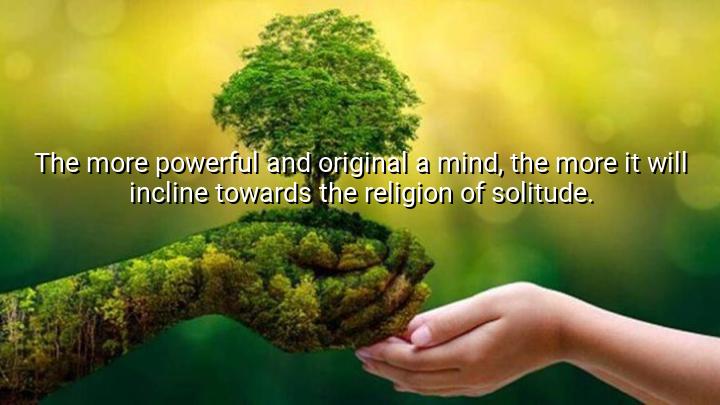




The quote "The more powerful and original a mind, the more it will incline towards the religion of solitude" by Aldous Huxley speaks to the idea that individuals with highly intellectual or creative abilities often find themselves drawn to periods of solitude for deeper reflection and personal growth. Huxley, a British writer and philosopher, was known for his explorations of human consciousness, society, and individual thought. In this statement, he suggests that great minds, when searching for clarity or working on original ideas, may feel the need for isolation in order to think freely and connect more profoundly with their inner selves.
The reference to the "religion of solitude" implies that solitude becomes not just a personal preference, but a kind of spiritual practice for such individuals. For Huxley, solitude is more than just being alone—it is a state of mindfulness or contemplation that allows one to cultivate ideas, reflect on existence, and engage with deeper truths that are harder to access in the hustle and bustle of social life. This "religion" does not refer to any organized doctrine but rather to an inward journey where the individual seeks answers and meaning through isolation and quietude.
Huxley’s statement also reflects his belief in the power of introspection and the vital role that solitude plays in fostering creativity and originality. Those who are capable of thinking in unique and groundbreaking ways may find that conventional social environments stifle their creativity or distract from their intellectual pursuits. Thus, they are inclined to embrace solitude as a necessary space for innovation, personal discovery, and mental clarity.
Ultimately, this quote points to the notion that solitude is not a retreat from the world, but a fertile ground for intellectual and spiritual development. Powerful and original minds may be drawn to solitude because it offers the freedom to explore ideas without the constraints of external influences. For Huxley, it is a sacred, self-imposed discipline—a way for individuals to tap into their deepest potentials and create meaning in their lives and work.

AAdministratorAdministrator
Welcome, honored guests. Please leave a comment, we will respond soon