

The mind, in proportion as it is cut off from free communication with nature, with revelation, with God, with itself, loses its life, just as the body droops when debarred from the air and the cheering light from heaven.
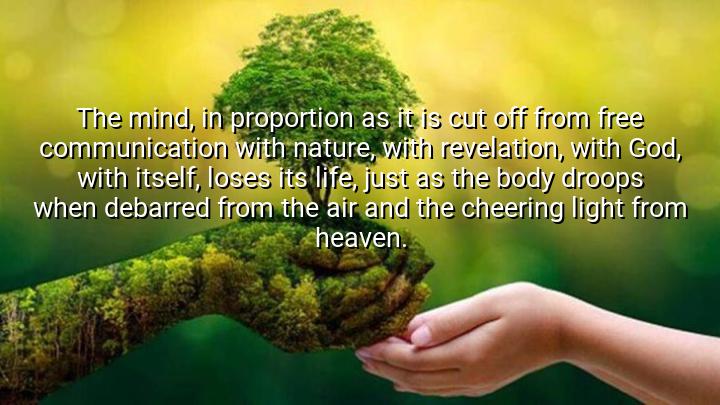




The quote by William Ellery Channing — “The mind, in proportion as it is cut off from free communication with nature, with revelation, with God, with itself, loses its life, just as the body droops when debarred from the air and the cheering light from heaven.” — is a profound reflection on the spiritual and intellectual vitality of the human mind. Channing suggests that when the mind is isolated from meaningful connections—to nature, divine insight, self-awareness, and spiritual truth—it begins to wither, much like a body deprived of sunlight and fresh air. The analogy draws attention to the essential nourishment the mind receives from spiritual and existential engagement.
The origin of this quote lies in Channing’s 19th-century sermons and writings, which were central to the development of American Unitarianism. As a leading theologian, preacher, and moral philosopher, Channing advocated for individual conscience, rational religion, and the inherent dignity of human nature. This quote reflects his belief that true mental and spiritual growth cannot occur in isolation or through mechanical routine—it requires active and free communication with the divine, the natural world, and one’s inner self.
By linking the mind’s vitality to its relationship with higher truths and natural elements, Channing implies that intellectual stagnation and spiritual decay occur when these connections are severed. He places great emphasis on the freedom of thought, the importance of inner reflection, and the openness to divine revelation as necessary conditions for a healthy, thriving mind. Just as physical health is sustained by sunlight and clean air, spiritual and intellectual health requires exposure to truth, beauty, and moral purpose.
Ultimately, Channing’s quote is a call to nurture the soul by staying in touch with what gives it life—God, nature, and conscious reflection. He warns against the dangers of mental confinement and encourages a more expansive, enlightened existence. His message is timeless: to flourish as human beings, we must actively seek and maintain open channels of communication with the deeper realities of our world and our inner lives.

AAdministratorAdministrator
Welcome, honored guests. Please leave a comment, we will respond soon