

The glories of our blood and state, Are shadows, not substantial things; There is no armour against fate, Death lays his icy hand on kings. Scepter and crown must tumble down, And, in the dust, be equal made With the poor crooked scythe and spade.
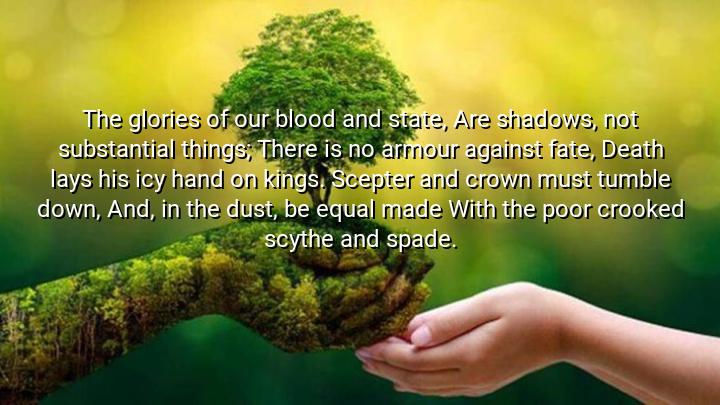




The quote by James Shirley, an English dramatist, reflects on the inevitability of death and the fleeting nature of power and status. Shirley highlights that the glories of one's blood (heritage) and state (position or authority) are ultimately insubstantial—mere shadows that cannot protect anyone from the inevitable fate that is death. The line "Death lays his icy hand on kings" emphasizes that death is impartial and will come for everyone, regardless of their rank or power.
Shirley’s use of imagery—scepter, crown, and the poor crooked scythe and spade—illustrates the contrast between the symbols of monarchy and the humble tools of the common man. Both the king’s scepter and the peasant’s spade are rendered equal in the face of death, showing that no matter the wealth, title, or authority one may hold, death ultimately brings them all to the same end. The dust symbolizes the return to nothingness, where even the most powerful are reduced to the same state as the poorest.
The origin of this quote is tied to Shirley’s work in seventeenth-century English theatre. As a playwright, Shirley often explored themes of mortality, fate, and social hierarchies. His work reflects the philosophical contemplation of human life and the universal nature of death. This quote resonates with the Baroque era's focus on the transience of life and the moral lessons of humility, often portrayed in art and literature of the time.
In essence, Shirley’s quote is a meditation on the transitory nature of power and the egalitarian nature of death. It serves as a reminder that no matter one's position in life, death will eventually equalize all. The quote encourages a reflection on the impermanence of worldly status and wealth, urging individuals to remain mindful of their mortality and the fleeting nature of their time and power.

AAdministratorAdministrator
Welcome, honored guests. Please leave a comment, we will respond soon