

The future is going to be boring. The suburbanisation of the planet will continue, and the suburbanisation of the soul will follow soon after.
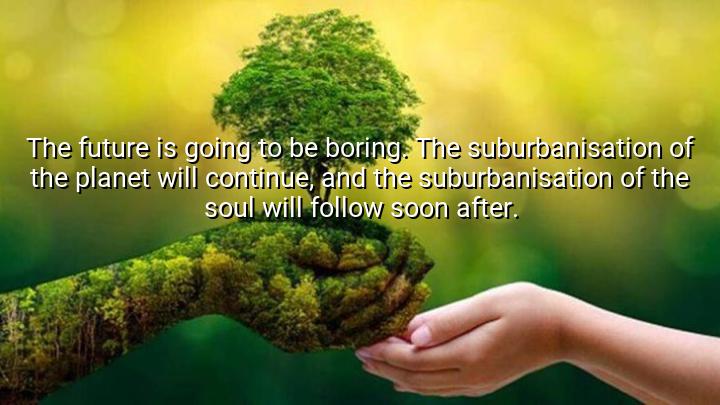




The quote by J.G. Ballard expresses a dystopian vision of the future, suggesting that as the world becomes more suburbanized, both physically and metaphorically, it will lose its excitement and complexity. Ballard predicts that the trend of suburbanisation—where cities spread out into vast, monotonous residential areas—will continue, leading to a homogenized world. He believes that this physical transformation will be mirrored by a "suburbanisation of the soul," implying a cultural and emotional shift toward banality and lack of depth or individuality.
Ballard’s reference to the suburbanisation of the soul suggests that, as the physical landscape becomes more uniform and predictable, people will also become more conformist and disengaged from creativity, diversity, and spontaneity. The metaphor points to how the blandness of suburban life—often characterized by uniform homes, commercial centers, and lack of personal expression—can lead to a stifling of personal growth, emotion, and imagination. According to Ballard, the future will be dull not just in its appearance but in its very essence, as people lose their ability to think outside the box or break away from societal norms.
The origin of the quote lies in Ballard’s work as a novelist and essayist, known for his explorations of postmodernity, technological advancements, and the psychological effects of urbanization. Ballard often focused on the alienating and dehumanizing effects of modern life, particularly the rise of consumerism and mass society. His writing, particularly in novels like Crash and High-Rise, explores the darker sides of human behavior as it interacts with an increasingly mechanized and regulated world.
Ultimately, Ballard’s quote reflects his pessimism about the direction in which modern society is heading. By foreseeing a future that is not only physically uniform but emotionally flat, he raises a concern about the loss of individuality and the potential for cultural stagnation. His warning serves as a critique of modernity and a call to recognize the dangers of an overly regulated, uniform future that could leave little room for creativity, freedom, or true human connection.

AAdministratorAdministrator
Welcome, honored guests. Please leave a comment, we will respond soon