

The field of AI has traditionally been focused on computational intelligence, not on social or emotional intelligence. Yet being deficient in emotional intelligence (EQ) can be a great disadvantage in society.
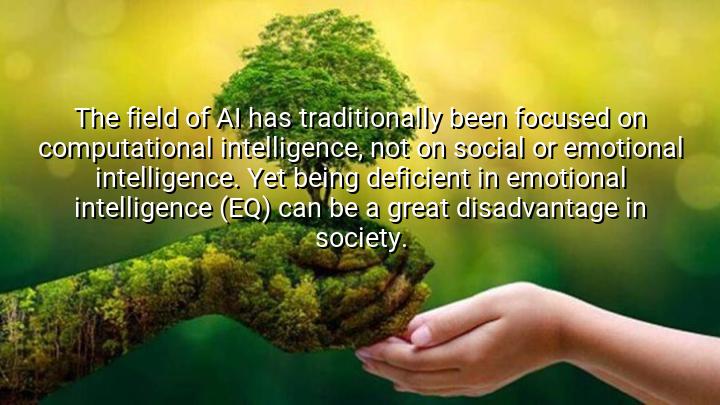




In this quote, Rana el Kaliouby highlights a significant gap in the field of artificial intelligence (AI): its traditional focus on computational intelligence rather than social or emotional intelligence (EQ). She points out that while AI has advanced in areas such as problem-solving, data analysis, and logical reasoning, it has often neglected the human aspects of intelligence that involve understanding emotions, social cues, and interpersonal dynamics. Emotional intelligence is crucial in human interactions, and being deficient in it can lead to significant challenges, both for individuals and for AI systems trying to interact effectively with people.
El Kaliouby emphasizes that emotional intelligence plays a vital role in our social interactions and well-being. The ability to recognize, understand, and manage emotions is essential not only for personal relationships but also for success in various aspects of life, such as work, education, and mental health. The absence of emotional intelligence can create misunderstandings and hinder effective communication. As AI systems become more integrated into our daily lives, developing machines that understand and respond to human emotions will be essential for their success and acceptance in society.
The origin of this quote comes from el Kaliouby’s work as a leader in the field of affective computing, a branch of AI that focuses on enabling machines to recognize and interpret human emotions. As the co-founder of Affectiva, a company that develops emotion recognition technology, she has been at the forefront of efforts to teach machines how to understand human feelings. Her research reflects a growing recognition of the importance of EQ in AI, particularly as the technology becomes more embedded in areas like healthcare, education, and customer service.
Ultimately, el Kaliouby’s quote underscores the importance of emotional intelligence in creating AI systems that can engage meaningfully with humans. It suggests that to truly benefit society, AI must move beyond pure computational tasks and learn to understand the emotional and social dimensions of human life, bridging the gap between technology and the nuanced ways people think and feel.

AAdministratorAdministrator
Welcome, honored guests. Please leave a comment, we will respond soon