

The evil of slavery and colonialism was that these oppressions kept their victims out of history, disconnected them from the evolutionary struggle.
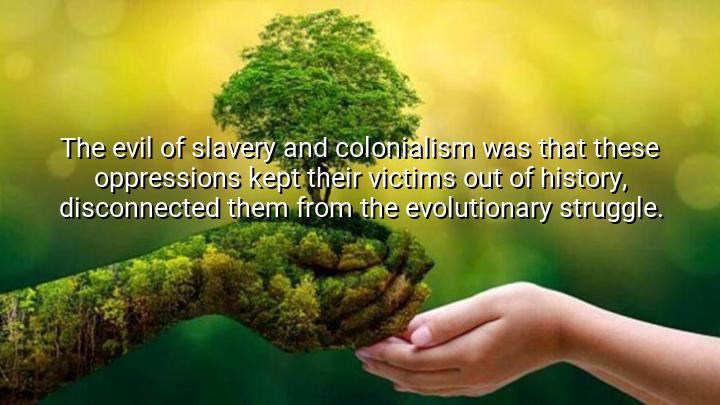




The quote by Shelby Steele highlights the profound impact of slavery and colonialism on the people who suffered under them. By describing their greatest evil as keeping victims “out of history,” Steele means that these systems denied enslaved and colonized peoples the ability to define themselves, shape their destinies, or contribute fully to the ongoing human story. Instead, their identities and narratives were suppressed, distorted, or erased by those in power.
When Steele says they were “disconnected … from the evolutionary struggle,” he emphasizes that oppression prevented these groups from participating equally in the broader progress of humanity. History, as he frames it, is not just a record of events but a collective process of growth, adaptation, and advancement. By stripping people of agency, slavery and colonialism excluded them from this process, leaving deep cultural and psychological wounds.
This perspective underscores how oppression is not only about physical exploitation but also about cultural disinheritance. The victims were denied recognition of their traditions, voices, and contributions, forcing them into invisibility within the dominant narrative of history. In this way, Steele draws attention to the long-term effects of oppression on identity, self-determination, and collective memory.
The origin of this quote lies in Steele’s role as an American author, intellectual, and social critic, known for exploring issues of race, identity, and politics. Much of his work deals with the legacy of slavery and segregation in the United States, as well as the psychological consequences of oppression. This quote reflects his broader view that reclaiming a place in history is essential for overcoming the lingering effects of racial injustice and for restoring dignity to those historically marginalized.

AAdministratorAdministrator
Welcome, honored guests. Please leave a comment, we will respond soon