

The environmental movement, like all political processes, reacts best to disasters. But these are very slow, very gradual disasters in the making.
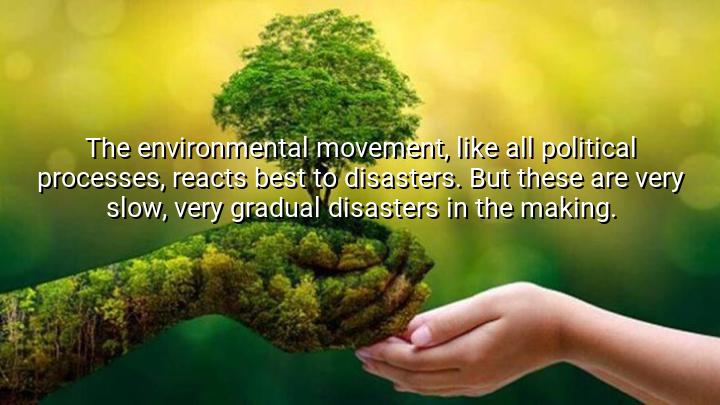




Ted Danson’s quote reflects on the reactive nature of the environmental movement and its tendency to respond more effectively to disasters. Danson suggests that while environmental issues are often urgent and critical, the movement is more galvanized by visible, acute crises. This could refer to major events, such as oil spills or wildfires, that capture widespread attention and prompt immediate action. However, Danson underscores that environmental problems often develop slowly, through gradual disasters that unfold over time, such as climate change and biodiversity loss. These issues are harder to perceive and, therefore, tend to be less urgent in the public consciousness.
Danson’s point is that while environmental issues might seem pressing, the slow and gradual nature of many ecological crises makes them less likely to spark a collective or political response. Unlike sudden and catastrophic events, which demand immediate action, long-term environmental damage doesn’t always prompt swift or sufficient measures. The disasters Danson refers to include the gradual degradation of the planet’s ecosystems, which can take decades or even centuries to become fully apparent.
The quote also speaks to the broader challenge of political processes in addressing complex, long-term issues. Danson suggests that these systems are designed to react to immediate and dramatic events, but they often struggle to respond to the gradual erosion of the environment. It points to a fundamental flaw in the way environmental policy is shaped, where the urgency of climate change or pollution is only recognized when it reaches a crisis point, rather than being actively prevented or mitigated over time.
Danson, an actor and environmental advocate, has long been involved in raising awareness about ocean conservation and environmental issues. His quote draws attention to the importance of proactive environmental action, urging a shift in how we perceive and address the planet's ecological challenges. He suggests that in order to avoid larger crises, the environmental movement must learn to address slow-moving disasters before they reach a catastrophic point.

AAdministratorAdministrator
Welcome, honored guests. Please leave a comment, we will respond soon