

The education I received was a British education, in which British ideas, British culture, British institutions, were automatically assumed to be superior. There was no such thing as African culture.
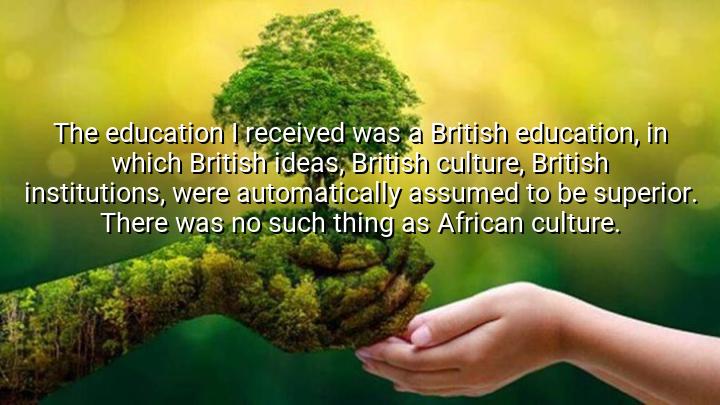




The quote “The education I received was a British education, in which British ideas, British culture, British institutions, were automatically assumed to be superior. There was no such thing as African culture.” by Nelson Mandela reflects his critique of colonial education in South Africa. Mandela highlights how the system was designed not to celebrate African culture, but to instill the belief that British culture was inherently superior. This kind of education was less about empowering Africans and more about reinforcing colonial dominance by erasing or devaluing indigenous traditions and knowledge.
By stating that there was “no such thing as African culture,” Mandela draws attention to how colonial education marginalized local identity. Students were taught to admire and emulate British institutions while being alienated from their own heritage. This created a sense of cultural inferiority, as generations of Africans were denied recognition of their history, values, and traditions. Mandela’s words expose the way in which education was used as a political tool to suppress and control.
The origin of this thought comes from Mandela’s own life experiences under apartheid and colonial rule. Educated in mission schools and later at institutions influenced by the British system, Mandela experienced firsthand how education was structured to favor European ideals. His later political career, particularly in fighting apartheid, was driven by the conviction that reclaiming and affirming African identity was essential to achieving freedom and equality.
In essence, Mandela’s quote reminds us that education is never neutral—it can either liberate or oppress. In his case, it was used to strip away cultural identity, but it also planted the seeds of resistance by showing him the injustices of colonialism. His reflection highlights the importance of creating educational systems that honor and integrate local cultures, rather than suppress them in favor of imposed ideals.

AAdministratorAdministrator
Welcome, honored guests. Please leave a comment, we will respond soon