

The doctor has been taught to be interested not in health but in disease. What the public is taught is that health is the cure for disease.
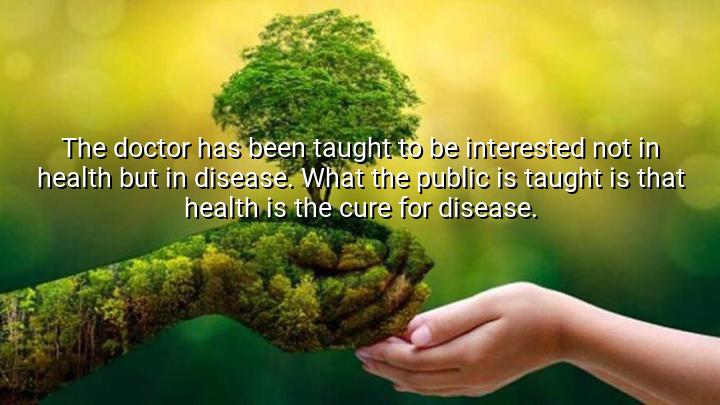




Ashley Montagu’s quote critiques the way medicine and healthcare are approached by both doctors and the public. He argues that doctors are primarily trained to focus on disease, diagnosing, treating, and managing illnesses, rather than emphasizing the importance of overall health and well-being. This suggests that the medical profession is more reactive than proactive, responding to illness rather than fostering prevention and promoting long-term health.
The quote also reflects a broader critique of how the public perceives health. Montagu points out that people are generally taught to think of health as merely the absence of disease—a condition that can be restored or achieved once an illness is cured. This mindset fails to address the more holistic approach to health, where maintaining a balance of physical, mental, and emotional well-being is key to preventing illness in the first place. In essence, health is seen as a state to be restored rather than an ongoing, proactive lifestyle.
Montagu's insight suggests a paradigm shift in how we approach healthcare. Instead of focusing on curing disease, there needs to be a greater emphasis on promoting and maintaining good health to prevent disease. This would involve a more balanced approach, incorporating lifestyle changes, nutrition, exercise, and mental health care, rather than waiting for symptoms to appear and then addressing them.
The origin of Montagu’s quote likely stems from his work in anthropology and his advocacy for a more holistic view of health. By pointing out this gap between disease treatment and health promotion, Montagu was encouraging a deeper understanding of well-being that extends beyond simply curing diseases. His quote calls for a shift in both medical training and societal attitudes toward health, promoting a more preventive and sustainable approach to healthcare.

AAdministratorAdministrator
Welcome, honored guests. Please leave a comment, we will respond soon