

The desire to live in our imagination is driven by this suspicion that we're disembodied sensibilities cobbled into our bodies. That idea has infused most of human thought since the very beginning.
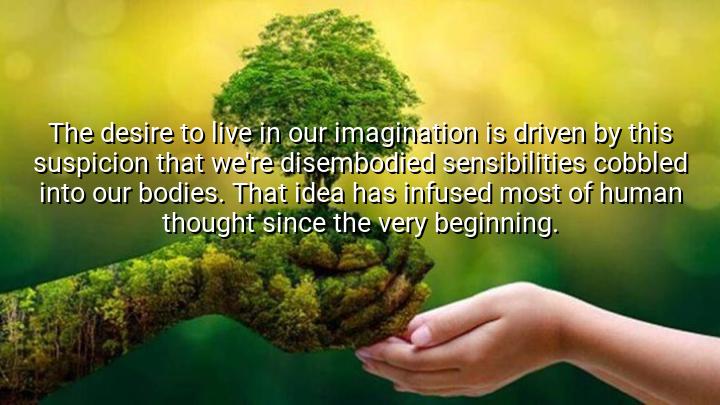




In this quote, Richard Powers explores the idea that the desire to live in our imagination stems from a deep-rooted belief that humans are essentially disembodied sensibilities—mental and emotional beings trapped in physical forms. Powers suggests that we often perceive ourselves as more than just our bodies, and that there is a sense of disconnect between our physical selves and our inner thoughts, emotions, and consciousness. This idea creates a longing to escape into the imagination, a realm where the constraints of the body are no longer present, and we can freely explore our inner worlds.
Powers links this concept to a broader philosophical and historical framework, indicating that the idea of being disembodied has been a recurring theme in human thought since the earliest stages of civilization. This belief has influenced many intellectual traditions, from ancient philosophy to modern psychology, suggesting that the mind and body are often seen as separate entities. The tension between the two has been a source of existential reflection for centuries, as people try to reconcile the nature of their existence and their place in the world.
The quote also touches on how imagination serves as a way to transcend the limitations of the physical body. By immersing ourselves in the imaginative world, we are able to experience freedom from the constraints of the physical realm, where our thoughts and desires are not bound by the limitations of our bodies. This desire for imaginative escape speaks to a fundamental need for personal liberation and creative expression.
Ultimately, Powers’ quote invites us to reflect on the tension between mind and body, and how the imagination has provided a means of exploring and expressing this internal conflict. It suggests that our fascination with the imaginative realm is not just a passing fancy but a fundamental part of human nature, driven by a longstanding philosophical inquiry into the nature of self and existence.

AAdministratorAdministrator
Welcome, honored guests. Please leave a comment, we will respond soon