

The death penalty not only takes away the life of the person strapped to the table - it takes away a little bit of the humanity in each of us.
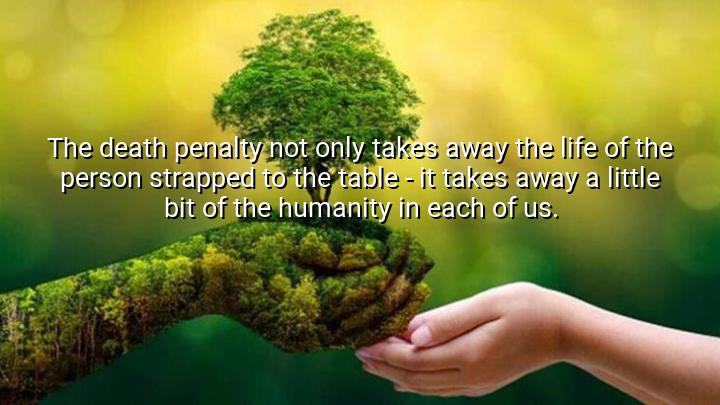




The quote by Clint Smith, an American poet and writer, reflects on the broader moral and humanitarian implications of the death penalty. Smith suggests that capital punishment does not only affect the person who is executed, but it also has a dehumanizing impact on society as a whole. By carrying out the death penalty, society participates in an act that diminishes the value of life and erodes a sense of shared humanity. In his view, the act of taking a life, even when legally sanctioned, ultimately corrupts the moral fabric of the community.
Smith’s statement highlights the ethical concerns surrounding the death penalty. While it may be justified in the eyes of some as a form of justice, he emphasizes that its practice, particularly in how it is implemented, reflects a deeper loss for everyone involved. The act of executing another person, he suggests, reduces everyone’s capacity for compassion and empathy, creating a society that is less connected to the fundamental value of human life.
The origin of this quote can be understood within Smith’s broader social and human rights advocacy, particularly around issues of racial justice and criminal justice reform. As an advocate for equity and the preservation of life, Smith has often spoken out against the death penalty, which he views as a flawed and morally questionable system. This quote encapsulates his belief that the death penalty has irreversible effects not only on the individual who is executed but also on the society that sanctions it.
In essence, Smith’s quote serves as a moral critique of the death penalty. It calls for reflection on the consequences of such practices, urging society to recognize that the taking of a life goes beyond the individual and impacts the collective moral conscience. By reducing a person’s life to an act of state-sanctioned violence, society risks losing a part of its own humanity in the process.

AAdministratorAdministrator
Welcome, honored guests. Please leave a comment, we will respond soon