

The death of democracy is not likely to be an assassination from ambush. It will be a slow extinction from apathy, indifference, and undernourishment.
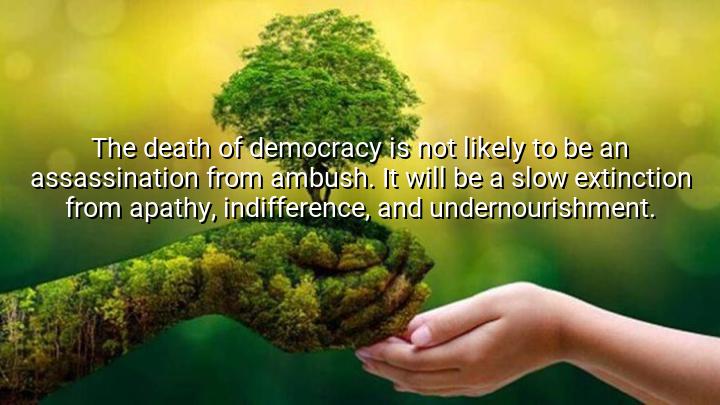




Robert M. Hutchins’ quote, "The death of democracy is not likely to be an assassination from ambush. It will be a slow extinction from apathy, indifference, and undernourishment," warns of the gradual and insidious decline of democratic systems due to a lack of active engagement and care from its citizens. Hutchins suggests that rather than democracy being destroyed by a sudden, dramatic event or force, it will erode slowly as people lose interest in or become disconnected from their civic duties. The metaphor of a "slow extinction" emphasizes that the death of democracy is not abrupt but a gradual process that occurs when democratic principles are not nurtured and maintained.
The quote highlights apathy and indifference as major threats to democracy. When citizens become disinterested or disengaged from the political process, they fail to advocate for their rights, make informed decisions, or hold their leaders accountable. This lack of involvement can lead to a weakening of democratic institutions and values, as democracy depends on the active participation of an informed populace. Undernourishment further suggests that democracy requires constant care, attention, and investment from society to thrive, much like a plant that needs water and nutrients to grow.
Hutchins’ warning underscores the idea that democracy is fragile and requires continuous effort to remain healthy. This quote reflects a concern for the growing disengagement from civic life, where people may feel disconnected from the democratic process or too disillusioned to participate. Hutchins calls for vigilance and active participation to preserve the vitality of democratic systems, suggesting that without it, democracy could fade away gradually rather than being destroyed by a dramatic external force.
The origin of this quote comes from Robert M. Hutchins, an American philosopher and educator known for his work in educational reform and his leadership at the University of Chicago. Hutchins was a prominent advocate for a liberal education and believed in the importance of an engaged, informed citizenry for the health of democratic society. This quote is a reflection of his concerns about the state of democracy and his belief that it requires constant attention and effort to thrive, rather than taking it for granted.

AAdministratorAdministrator
Welcome, honored guests. Please leave a comment, we will respond soon