

The death of a language. The word has the same kind of reluctant resonance as it has when we talk about the death of a person. And indeed, that's how it should be. For that's how it is. A language dies only when the last person who speaks it dies.
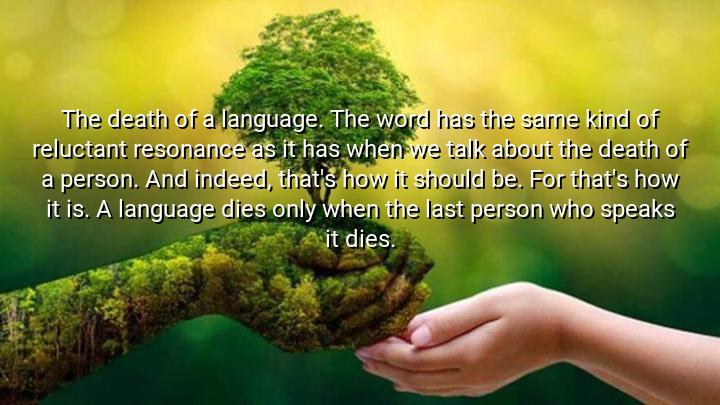




The quote by David Crystal, a renowned linguist, emphasizes the profound significance of the death of a language. Crystal compares the death of a language to the death of a person, suggesting that it carries a similar emotional weight and finality. Just as the death of an individual marks the loss of their presence and experiences, the death of a language signifies the disappearance of a unique way of thinking, communicating, and understanding the world. This comparison highlights the deep cultural and personal loss associated with a language's extinction.
Crystal’s statement underscores that a language is only truly dead when the last person who speaks it passes away. Until that point, even if a language is no longer widely spoken, it may still be preserved in certain communities or among individuals. The death of a language, therefore, is not just about the decline in the number of speakers but about the ultimate disappearance of its cultural and historical significance, which can never be fully revived once lost.
The origin of this quote stems from Crystal’s extensive research on the preservation of languages and his advocacy for the protection of endangered languages. He has written several works on linguistic diversity and the risks of language extinction. In this context, his quote serves as a poignant reminder of the fragility of languages and the need to value and protect them before they vanish, taking with them the knowledge and traditions that they represent.
In essence, Crystal’s quote calls attention to the irreplaceable nature of languages. It highlights the deep emotional and cultural loss that accompanies the death of a language, urging us to recognize the importance of preserving linguistic diversity. A language’s death is not simply a shift in communication but a loss of a unique worldview, making it essential to honor and protect these rich expressions of human heritage.

AAdministratorAdministrator
Welcome, honored guests. Please leave a comment, we will respond soon