

The day is not far off when the economic problem will take the back seat where it belongs, and the arena of the heart and the head will be occupied or reoccupied, by our real problems - the problems of life and of human relations, of creation and behavior and religion.
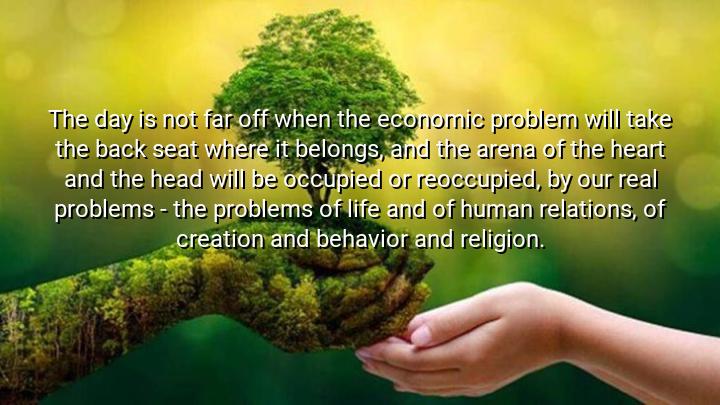




In this quote, John Maynard Keynes, a renowned economist, envisions a future in which economic problems are no longer the primary focus of society. He predicts that as society progresses, the emphasis will shift away from material wealth and economic growth, and instead, more attention will be given to deeper human issues such as life, human relations, creativity, behavior, and religion. Keynes is suggesting that while economics has dominated much of human thought and policy, it should eventually take a back seat to more profound questions about what it means to live a meaningful life and how humans relate to each other and the world around them.
Keynes’ mention of the economic problem taking a back seat reflects his belief in the limitations of economic theory to address the true challenges facing humanity. He argues that economic concerns, while important, are ultimately secondary to philosophical and spiritual questions. The "real problems" that he refers to are those that concern the soul, morality, and the essence of human existence, which cannot be solved by purely material or financial solutions. Keynes is hinting at a future where societies are not just judged by their economic success, but by their ability to solve more human and ethical challenges.
In this vision, Keynes recognizes that addressing these human problems requires not just economic or technical solutions, but a shift in how we view life, community, and individual purpose. He envisions a world where religion and personal behavior—questions of ethics, empathy, and values—become central to societal discourse and problem-solving. This reflects a belief that economic prosperity alone is insufficient for achieving true human flourishing, and that a deeper focus on creativity and interpersonal relationships is essential for a better world.
The origin of this quote is from John Maynard Keynes, an influential British economist best known for his ideas on macroeconomics and for his work in shaping modern economic policy. Although Keynes is often associated with capitalism and the regulation of markets, this quote shows that he recognized the limits of economic thinking in solving the deeper philosophical and spiritual issues that define the human experience. This reflects Keynes' broader intellectual framework, which acknowledged that economics is only one piece of the puzzle in the complex and nuanced journey of human life.

AAdministratorAdministrator
Welcome, honored guests. Please leave a comment, we will respond soon