

The current state of knowledge is a moment in history, changing just as rapidly as the state of knowledge in the past has ever changed and, in many instances, more rapidly.
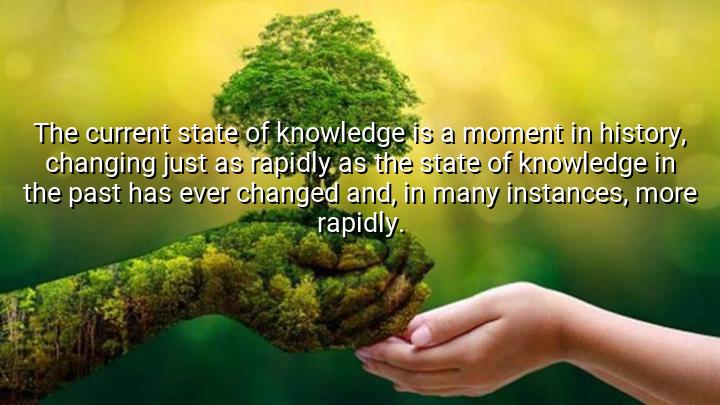




The quote by Jean Piaget emphasizes the dynamic and evolving nature of knowledge. Piaget suggests that the understanding and accumulation of information at any given moment is only a snapshot in history, reflecting the current limits and scope of human learning. Knowledge is never static; it constantly develops as new discoveries are made and ideas are challenged, just as it has throughout human history.
By noting that knowledge changes "in many instances, more rapidly," Piaget highlights the accelerating pace of intellectual advancement in modern times. Scientific discoveries, technological innovations, and shifts in cultural and philosophical understanding contribute to an environment where what is accepted as true or factual can transform quickly. This underscores the importance of adaptability, critical thinking, and lifelong learning in keeping pace with evolving knowledge.
The quote also points to the idea that learning and understanding are processes rather than final states. No matter how much we know at any moment, our grasp of truth is provisional, shaped by the current state of knowledge. Piaget’s perspective encourages humility and curiosity, acknowledging that human understanding is always incomplete and subject to revision.
Originating from Jean Piaget, a Swiss psychologist and pioneer in the study of cognitive development, the quote reflects his insights into how humans acquire, construct, and adapt knowledge. Piaget’s work focused on the processes by which individuals, especially children, build understanding over time, and this quote captures his broader recognition of knowledge as a continually changing and historically situated phenomenon.

AAdministratorAdministrator
Welcome, honored guests. Please leave a comment, we will respond soon