

Our problem, from the point of view of psychology and from the point of view of genetic epistemology, is to explain how the transition is made from a lower level of knowledge to a level that is judged to be higher.
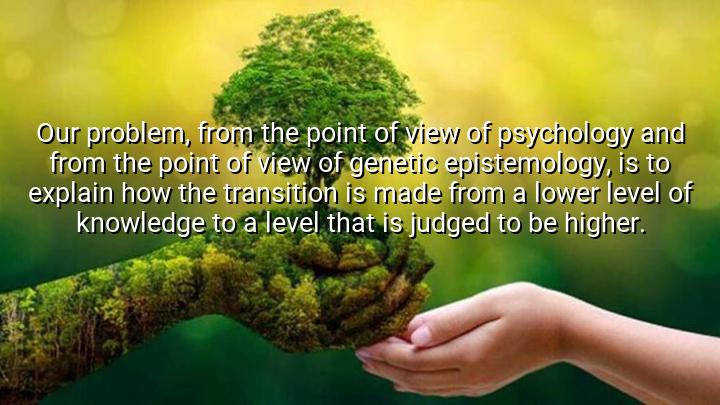




The quote by Jean Piaget focuses on the development of knowledge and the process by which humans move from simple understanding to more complex forms of reasoning. When he says, “Our problem, from the point of view of psychology and from the point of view of genetic epistemology, is to explain how the transition is made from a lower level of knowledge to a level that is judged to be higher,” Piaget is emphasizing the need to understand the mechanisms of cognitive growth. It is not enough to know what people understand at different stages; the key challenge is to explain the process of advancement in knowledge.
Piaget’s reference to genetic epistemology highlights his focus on the origins and development of knowledge in individuals, particularly in children. He believed that knowledge is not static but evolves through interaction with the environment, problem-solving, and adaptation. The “lower level of knowledge” represents early or incomplete understanding, while the “higher level” refers to more sophisticated, organized, and abstract thinking. The transition involves both cognitive restructuring and experiential learning.
Jean Piaget, a Swiss developmental psychologist and philosopher, is renowned for his studies on child development and the stages of cognitive growth. This quote reflects his commitment to exploring how humans construct knowledge, rather than merely cataloging what they know at a given moment. His work laid the foundation for modern theories of learning, education, and cognitive psychology, emphasizing the dynamic nature of intellectual development.
Ultimately, the quote underlines the importance of understanding the process of learning, not just the outcomes. It encourages educators, psychologists, and researchers to focus on how knowledge evolves, recognizing that growth from simpler to more advanced levels of understanding is a complex, structured, and ongoing journey. This perspective highlights the interplay between experience, reasoning, and cognitive maturation in the acquisition of knowledge.

AAdministratorAdministrator
Welcome, honored guests. Please leave a comment, we will respond soon