

The cure for all the ills and wrongs, the cares, the sorrows, and the crimes of humanity, all lie in the one word 'love'. It is the divine vitality that everywhere produces and restores life.
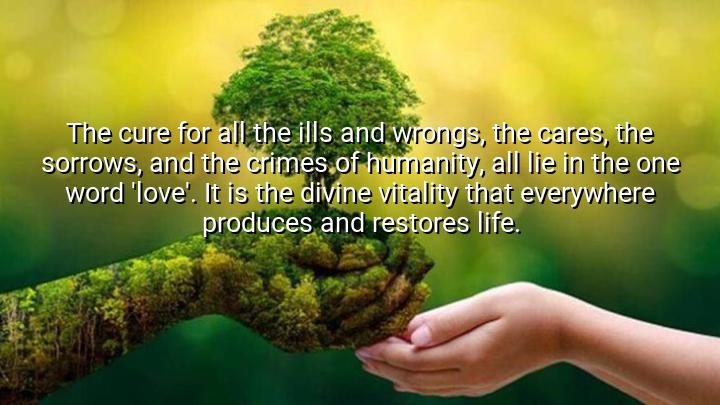




The quote by Lydia M. Child, “The cure for all the ills and wrongs, the cares, the sorrows, and the crimes of humanity, all lie in the one word 'love'. It is the divine vitality that everywhere produces and restores life,” emphasizes the transformative and restorative power of love. Child suggests that love is the ultimate solution to human suffering, injustice, and conflict, portraying it as a force capable of addressing both personal and societal challenges.
By describing love as a divine vitality, Child highlights its spiritual and universal significance. Love is not merely an emotion but a life-giving energy that nurtures, heals, and revitalizes. It produces growth, restores balance, and inspires ethical and compassionate action, showing its ability to reconnect humanity with virtue and purpose.
The origin of this quote lies in Child’s work as an American abolitionist, women’s rights activist, and author in the 19th century. Known for her writings on social reform, morality, and humanitarianism, Child frequently emphasized the role of love, compassion, and ethical responsibility as foundational to improving society. This quote reflects her belief that moral and social progress is rooted in the capacity for human beings to love selflessly.
Overall, the quote illustrates Child’s conviction that love is a powerful and essential force. By presenting it as the cure for human suffering and wrongdoing, she underscores its ability to transform individuals and societies, portraying love as both a practical and divine principle that sustains and restores life.

AAdministratorAdministrator
Welcome, honored guests. Please leave a comment, we will respond soon