

The bones of my architecture are very much related to the structure, to the physical fact of how a building can stand up; it's also related to geometry and a certain understanding of the architecture in which there is a balance between expression and function.
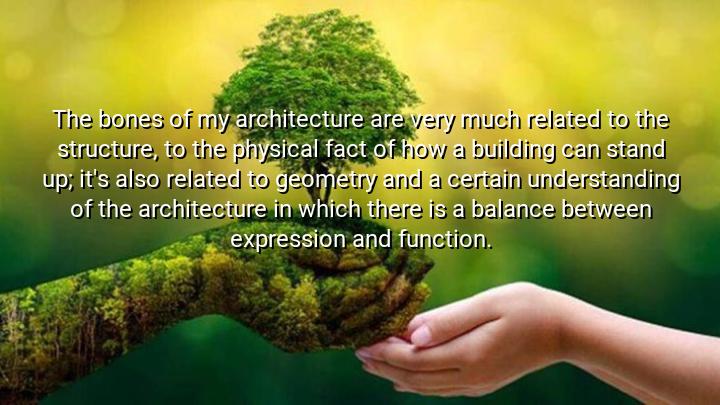




The quote by Santiago Calatrava, “The bones of my architecture are very much related to the structure, to the physical fact of how a building can stand up; it's also related to geometry and a certain understanding of the architecture in which there is a balance between expression and function,” reflects his philosophy of merging engineering precision with artistic expression. Calatrava, both an architect and a civil engineer, views structure as the core skeleton—or "bones"—of architecture, emphasizing that the integrity of a building starts with how it is physically constructed and how it achieves balance and support.
His reference to geometry highlights the mathematical and spatial logic that underpins his architectural style. For Calatrava, geometry isn’t just a tool for measurement; it is a source of beauty, proportion, and harmony. This mathematical clarity is visible in his designs, which often feature sweeping curves, dynamic forms, and organic shapes that mimic natural structures like wings, spines, and leaves. He uses geometry to ensure that the structural foundation is not only sound but also aesthetically compelling.
The phrase “a balance between expression and function” captures the central principle of Calatrava’s work: architecture should be both visually poetic and practically sound. While many of his buildings—such as the City of Arts and Sciences in Valencia or the Milwaukee Art Museum—are admired for their sculptural boldness, they are also rooted in engineering logic. Calatrava rejects the separation of form and function; instead, he weaves them together, believing that structural necessity can be a source of creative expression.
The origin of this quote comes from Calatrava’s interviews and writings, where he often discusses his dual identity as an engineer-artist. He is part of a lineage of architects who view technical mastery not as a limitation, but as a foundation for innovation and beauty. Through this quote, he articulates his belief that architecture must stand, not only physically but intellectually and emotionally, through the thoughtful integration of structure, geometry, and artistic vision.

AAdministratorAdministrator
Welcome, honored guests. Please leave a comment, we will respond soon