

The arts have always been an important ingredient to the health of a nation, but we haven't gotten there yet.
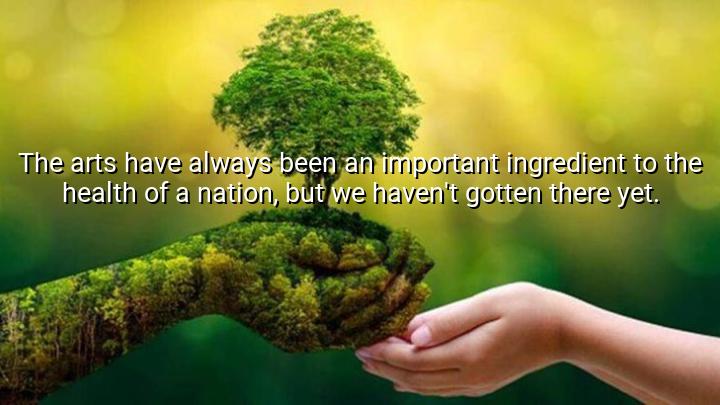




In this quote, James Earl Jones emphasizes the vital role the arts play in sustaining the health of a nation. He asserts that creative expression, cultural heritage, and artistic endeavors are essential ingredients in building a vibrant, resilient society. However, by adding “we haven’t gotten there yet,” Jones implies that society has not fully embraced or prioritized the arts to the extent necessary to achieve their full benefits. His statement calls attention to the gap between recognizing the importance of the arts and actively supporting them in public policy, education, and community life.
Jones’s use of the word “ingredient” frames the arts as an essential component—just like education, healthcare, or civic engagement—in maintaining a nation’s overall well-being. The arts can inspire creativity, promote empathy, and strengthen cultural identity, all of which contribute to societal health in both tangible and intangible ways. Yet, his acknowledgment that “we haven’t gotten there yet” suggests that funding, accessibility, and cultural value for the arts are still lacking in many parts of society, preventing them from reaching their full potential as a unifying and uplifting force.
The origin of this quote lies in James Earl Jones’s lifelong advocacy for the arts and his own experiences as a celebrated actor. Known for his deep voice and powerful performances, Jones has been a vocal supporter of arts education and the belief that exposure to theatre, music, and visual arts enriches lives. His career, which spans stage, film, and television, gives him a unique vantage point to see how the arts can transform individuals and communities, but also how often they are undervalued in societal priorities.
Ultimately, Jones’s quote is both a recognition and a challenge: a recognition of the arts as essential to the health of a nation, and a challenge to elevate them to the same level of importance as other foundational aspects of society. By urging society to “get there,” he is calling for increased commitment, investment, and cultural recognition so that the arts can fulfill their role in shaping a healthy, creative, and connected nation.

AAdministratorAdministrator
Welcome, honored guests. Please leave a comment, we will respond soon