

That neither our thoughts, nor passions, nor ideas formed by the imagination, exist without the mind, is what every body will allow.
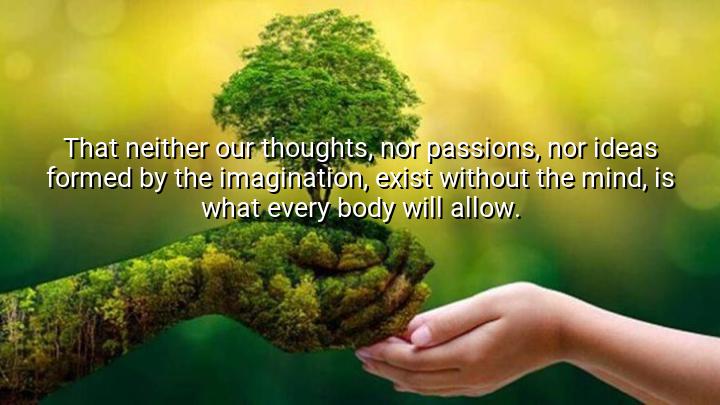




The quote, "That neither our thoughts, nor passions, nor ideas formed by the imagination, exist without the mind, is what everybody will allow," comes from George Berkeley, an influential Irish philosopher best known for his work in idealism. Berkeley’s philosophy asserts that the physical world and its objects only exist in the mind. His famous principle of "esse est percipi" (to be is to be perceived) holds that objects do not exist independently of our perception of them, which is central to his arguments on the nature of reality.
In this quote, Berkeley is emphasizing the idea that thoughts, passions, and ideas are all products of the mind. These mental states cannot exist without the mind itself, as they are inherently tied to it. By stating that "everybody will allow" this concept, Berkeley suggests that it is a widely accepted understanding, at least in relation to subjective experiences. Essentially, it reinforces the idea that mental phenomena are dependent on the mind to exist, and without it, these experiences cannot be formed or perceived.
Berkeley's view challenges the notion that the physical world exists independently of the mind. He argues that what we perceive as the external world is, in fact, a series of mental constructs shaped by our senses. In this sense, he is not denying the existence of the world, but rather asserting that it only has existence as it is perceived by the mind. His work sought to demonstrate that all things—whether thoughts or material objects—are deeply connected to our consciousness.
Ultimately, Berkeley’s philosophy centers around the interdependence of the mind and all mental phenomena. This quote encapsulates his belief that nothing, whether it’s a thought, a passion, or an idea, can exist without the mind. It is a foundational idea in his exploration of idealism, which challenges materialistic views of the world and emphasizes the role of perception and the mind in shaping reality.

AAdministratorAdministrator
Welcome, honored guests. Please leave a comment, we will respond soon