

Ten percent of the big fish still remain. There are still some blue whales. There are still some krill in Antarctica. There are a few oysters in Chesapeake Bay. Half the coral reefs are still in pretty good shape, a jeweled belt around the middle of the planet. There's still time, but not a lot, to turn things around.
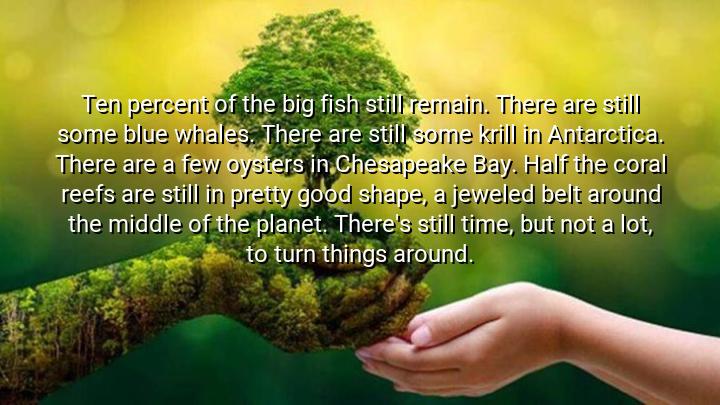




In this quote, Sylvia Earle provides a mix of hope and urgency regarding the state of the planet's ecosystems. She notes that while many of the world's most crucial marine species and habitats are under threat, there are still some that remain, including blue whales, krill in Antarctica, and coral reefs. The phrase “ten percent of the big fish still remain” underscores the reality that a significant portion of the ocean's biodiversity has been depleted, but there is still a chance for recovery if action is taken in time.
Earle’s reference to half the coral reefs still being in good condition speaks to the resilience of certain ecosystems, despite the damage they’ve faced. Coral reefs are often called the "rainforests of the sea" due to their biodiversity, and her mention of them being "a jeweled belt around the middle of the planet" highlights their essential role in supporting marine life. While these ecosystems are under threat from factors like climate change, pollution, and overfishing, she points out that there are still pockets of life that offer hope for their preservation.
The urgency in her statement, "there’s still time, but not a lot," reflects the critical need for action to protect these vulnerable ecosystems before they are irreparably damaged. Earle emphasizes that while there is still hope, the window for turning things around is closing rapidly. This is a call to action for individuals, governments, and organizations to invest in conservation and sustainable practices that can help protect the remaining biodiversity.
Ultimately, Sylvia Earle’s quote serves as both a reminder of the beauty and importance of marine life and a stark warning about the fragility of the ecosystems we depend on. It emphasizes that we still have the opportunity to make a difference, but only if we act quickly and collectively to protect the planet’s most precious natural resources.

AAdministratorAdministrator
Welcome, honored guests. Please leave a comment, we will respond soon