

Talent has no gender. People are hiring young male directors right out of film school, off of a student film or off of a film at Sundance for millions of dollars. You can do the same with a female. It's not a risk about the work if you respect the film that they made.
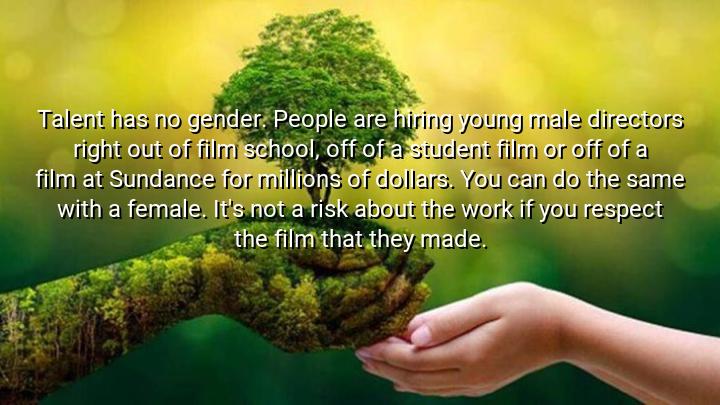




Gina Prince-Bythewood’s quote challenges the notion that gender should play a role in determining the success or potential of filmmakers. By stating, "Talent has no gender," she underscores the idea that creative ability, particularly in fields like directing, is not limited by one's sex or gender identity. She goes on to highlight the discrepancy in how male directors are given significant opportunities based on their work, citing examples of young male directors who are hired immediately after completing a student film or a Sundance film, despite their limited experience.
Prince-Bythewood emphasizes that the opportunity for a female director to achieve similar success should not be seen as a risk, particularly if her work has proven to be valuable and impactful. By stating, "You can do the same with a female," she asserts that there is no inherent risk in giving women the same opportunities afforded to men, as long as the work speaks for itself. This comment reflects her frustration with the systemic biases in the film industry that often marginalize women directors, despite their equal capabilities and talent.
The origin of this quote lies in Prince-Bythewood’s own experiences as a female director in an industry that has historically been dominated by men. Known for her work on films like Love & Basketball and The Secret Life of Bees, she has been a vocal advocate for gender equality in Hollywood. Prince-Bythewood’s career serves as a powerful example of how female filmmakers can succeed and make significant contributions, yet she continues to push for broader recognition and opportunity for all women in the industry.
In a broader context, this quote speaks to ongoing conversations about gender equality in entertainment and creative industries, urging a more inclusive approach to hiring practices. It challenges ingrained biases that position men as the default creators, advocating instead for the recognition of talent and the importance of respecting and promoting diverse voices in film. The statement serves as a reminder that a filmmaker’s gender should never overshadow their artistic vision and the value of their work.

AAdministratorAdministrator
Welcome, honored guests. Please leave a comment, we will respond soon