

Somehow, architecture alters the way we think about the world and the way we behave. Any serious architecture, as a litmus test, has to be that.
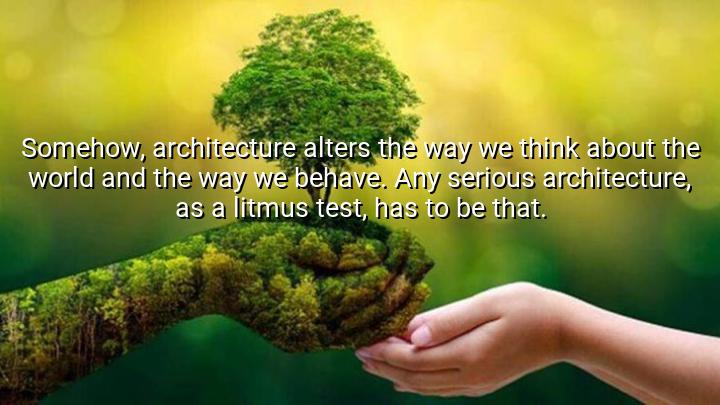




The quote by Thom Mayne, “Somehow, architecture alters the way we think about the world and the way we behave. Any serious architecture, as a litmus test, has to be that,” reflects his belief that architecture is not merely a physical or aesthetic discipline but a profound force that shapes human experience. Mayne, an influential American architect and founder of Morphosis, suggests that meaningful design goes beyond visual impact—it must engage with how people perceive, interact, and exist within space.
When Mayne says architecture alters the way we think and behave, he’s acknowledging that the built environment plays a direct role in influencing our moods, movements, and relationships. A well-designed space can inspire creativity, encourage social interaction, or promote reflection. On the contrary, poor design can limit freedom, stifle expression, or create psychological discomfort. Thus, serious architecture must aim to transform how people experience the world around them.
The mention of a litmus test underscores Mayne’s standard for what qualifies as impactful design. Just as litmus paper tests acidity, he implies that the test of good architecture is whether it creates a tangible shift in human consciousness and behavior. It’s not enough for a building to be functional or visually impressive—it must also challenge or elevate our understanding of space and community.
This quote is rooted in Mayne’s broader architectural philosophy, which often combines experimental form, urban complexity, and social relevance. Known for projects like the San Francisco Federal Building and the Perot Museum of Nature and Science, Mayne continuously advocates for architecture as an agent of change. His statement encapsulates a core ideal: that architecture, at its best, is a transformative medium, capable of reshaping not only cities but the very way we live and think.

AAdministratorAdministrator
Welcome, honored guests. Please leave a comment, we will respond soon