

I've always been interested in an architecture of resistance - architecture that has some power over the way we live. Working under adversarial conditions could be seen as a plus because you're offering alternatives. Still, there are situations that make you ask the questions: 'Do I want to be a part of this?'
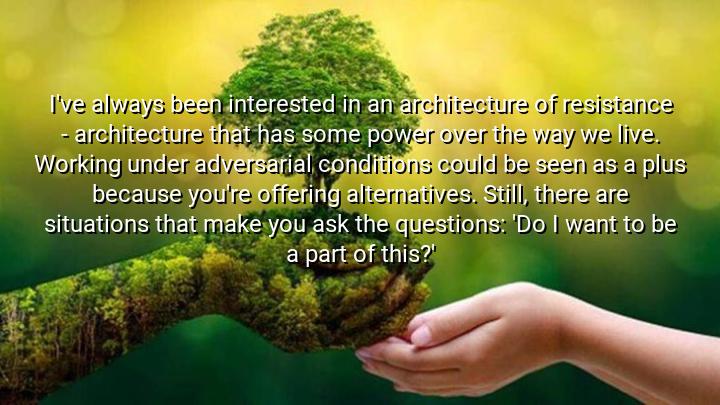




In this powerful quote, Thom Mayne, an influential American architect and founder of Morphosis, articulates his belief in an "architecture of resistance." By this, he means a form of architecture that challenges the status quo—one that questions conventional norms and seeks to transform the way we live. Rather than simply fulfilling functional or aesthetic demands, Mayne envisions architecture as a tool of critique and change, capable of shaping not only physical space but also social values and cultural attitudes.
Mayne further suggests that working under adversarial conditions—whether political, economic, or institutional—can be beneficial. These challenges can force architects to innovate, to develop alternatives that respond to constraints with creativity and resilience. In this context, architecture becomes a form of resistance: a way to confront mediocrity, conformity, or oppression by proposing bold and visionary solutions.
However, Mayne also acknowledges the ethical complexity of working in contentious or morally ambiguous situations. His rhetorical question, “Do I want to be a part of this?” reflects the moral responsibility architects face when deciding which projects to pursue. Not every commission aligns with one’s values, and sometimes the conditions of practice can force a designer to question their role, influence, and integrity within the broader system.
Ultimately, this quote encapsulates Mayne’s identity as a radical thinker in contemporary architecture—someone who believes that design is not just about building, but about questioning, resisting, and reimagining. His commitment to an architecture of resistance speaks to the idea that great architecture is not passive, but provocative, demanding active engagement with the social, political, and ethical dimensions of the built environment.

AAdministratorAdministrator
Welcome, honored guests. Please leave a comment, we will respond soon